TL;DR: A software flaw in Georgia's statewide voting system can allow ballots to be reordered and linked to voters, and researchers say AI assistants now make that linkage far easier to perform.
Security researchers warned that fast progress in artificial intelligence has raised the urgency of correcting a ballot-secrecy weakness in Georgia election equipment, according to PBS News.
The weakness does not change vote totals. It can instead reveal how individual people voted, which matters because secrecy is protected by the Georgia Constitution, according to PBS News.
What researchers say is at stake
The system's vulnerability has received growing attention ahead of the November elections, with advocates faulting state officials for not correcting it sooner, according to Fortune, which carried reporting by The Associated Press.
Georgia election officials say they have acted to reduce possible harm. Some advocates say those actions do not go far enough, according to PBS News.
The distinction matters for public understanding of election technology. The vulnerability does not permit alteration of selections and does not undermine confidence in counts, according to PBS News. It could nevertheless expose marked choices to another person.
That exposure matters because ballot secrecy is described as a fundamental right under the state constitution, according to PBS News. Violations could supply grounds for court disputes over election administration.
The underlying weakness has been known for a few years. What has changed is broad availability of AI assistants and accelerating improvement in their capabilities, according to PBS News.
J. Alex Halderman, a voting-technology specialist at the University of Michigan, was part of the group that first brought the weakness to light. He described the present moment as a wake-up call showing how readily AI can handle the technical steps, according to PBS News.
How Georgia voting creates the records at issue
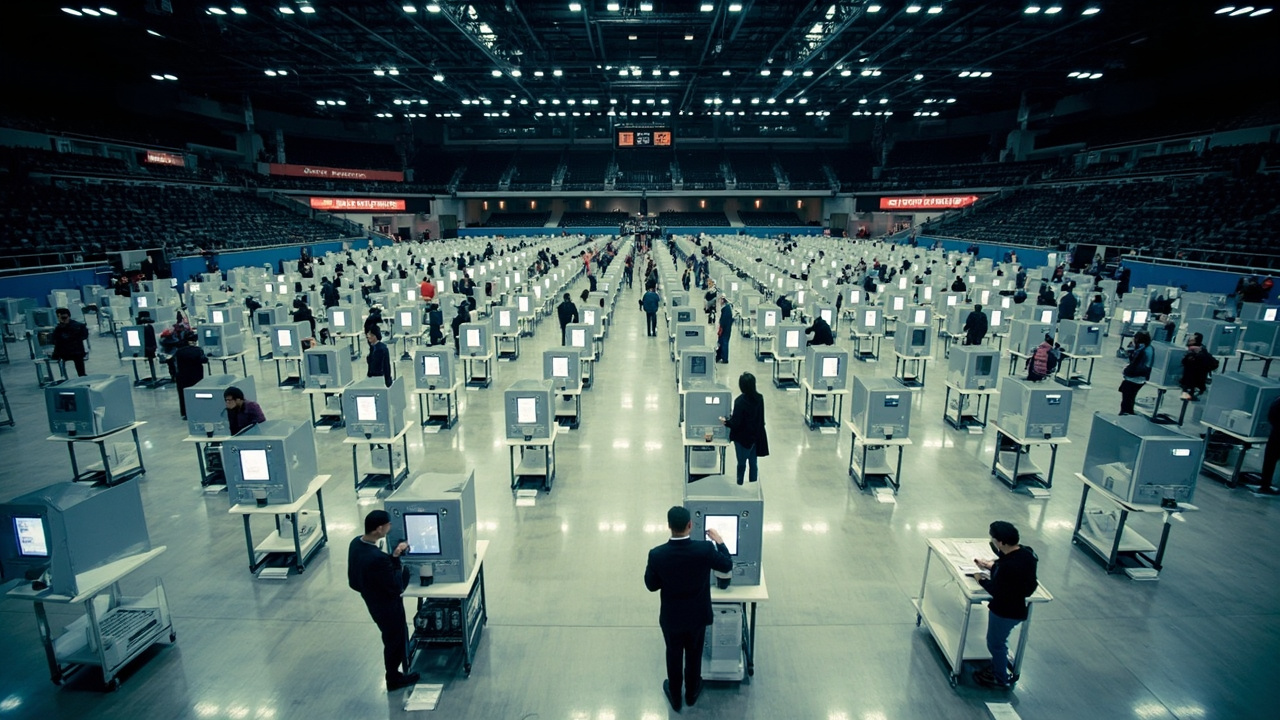
Georgia voters enter choices on touchscreen units. Those units produce printed paper ballots. Voters then place those printouts into scanners that count the votes, according to PBS News.
The scanners generate two kinds of electronic material. One category, called cast-vote records, describes the selections found on each ballot. The other category consists of electronic images of ballots, according to PBS News.
Both categories are supposed to be shuffled. Randomization is intended to prevent anyone from reconstructing the sequence in which people voted, according to PBS News.
A report by the researchers who identified the problem in 2022 found that the shuffling can be undone. The software weakness permits the records and images to be restored to casting order, according to PBS News.
Once sequence is restored, the ordered ballots can be compared with other publicly available election information. Together, those sources can point to the person who marked a particular ballot, the researchers wrote, according to PBS News.
Why AI changes the practical risk
Max Springer, a Princeton University researcher who studies AI and did not participate in the original 2022 work, tested whether a generally available AI assistant could perform the reconstruction, according to PBS News.
Springer supplied the assistant with the earlier research. The system was able to undo the shuffling of electronic ballot records from Georgia's May primary, according to PBS News.
The assistant then identified additional records that would be needed to connect ballot entries with names, according to PBS News.
Springer next provided two further inputs for the counties under review: the early-voting list and the cast-vote-record file, a file obtainable through a public-records request, according to PBS News.
With those inputs, the AI assistant grouped ballots and possible voters into corresponding sets, described in a blog post as buckets of ballots and potential voters, according to PBS News. In many cases, that grouping made identification possible.
Where uncertainty remained, Springer consulted scanner audit logs and precinct check-in records that were public, according to PBS News.
Those extra public logs resolved much of the remaining ambiguity and permitted most ballots to be associated with particular voters, he wrote, according to PBS News.
Springer said AI coding aids are effectively enabling nonspecialists to take advantage of technical weaknesses, according to PBS News.
Why Georgia faces more exposure than other users
The same equipment, produced by Dominion Voting Systems, is used in other jurisdictions around the country, according to Fortune, which carried reporting by The Associated Press.
Dominion has since been sold and renamed Liberty Vote, according to PBS News.
Many other users have installed a software correction that addresses the weakness, according to PBS News.
Some other states also restrict public disclosure of the records needed to carry out the linkage, according to PBS News.
Mark Lindeman, policy and strategy director at Verified Voting, a nonpartisan organization concerned with election technology, said those two differences leave Georgia unusually exposed, according to PBS News.
Georgia is the only state that uses the system statewide, according to PBS News.
Georgia is also a presidential battleground and has one of the country's most closely watched U.S. Senate contests this year, according to PBS News.
Lindeman said statewide use plus an open-records law that has permitted access to important documents creates a perfect storm, according to PBS News.
He called the continued possibility embarrassing, according to PBS News.
What state law requires
Georgia's Constitution states that elections shall be by secret ballot, according to PBS News.
State law separately requires voting machines to allow voting in absolute secrecy so that nobody can see or learn another voter's selections, according to PBS News.
Election-security advocates say secrecy is not merely symbolic. Loss of secrecy can simplify buying or selling votes, according to PBS News.
It can also heighten the risk of pressure to vote a particular way from relatives, political groups, employers or public officials, according to PBS News.
The information could additionally be valuable to political campaigns seeking detailed knowledge of voter behavior, according to PBS News.
How state officials answer the warnings
Gabriel Sterling, special projects manager in the secretary of state's office, questioned whether the linkage method would be an attractive tool for improper influence, according to PBS News.
Sterling said mail ballots would offer a simpler route for anyone seeking vote-buying or coercion, according to PBS News.
He also said campaigns would probably find it less expensive to expand outreach to voters matching a particular profile than to attempt identification through ballot records, according to PBS News.
State officials have said they have taken measures intended to limit harm, although advocates dispute whether those measures are sufficient, according to Fortune, which carried reporting by The Associated Press.
The disagreement comes as the November elections approach. Advocates have urged a complete technical correction before voting, while officials point to practical and procedural constraints, according to PBS News.
The failed proposal to require an update
State Election Board member Salleigh Grubbs proposed a rule at the board's August meeting that would have directed action on the manufacturer's recommended software update, according to PBS News.
The proposal set Tuesday as the deadline for the secretary of state's office to apply that update, according to PBS News.
Grubbs said every voter has one vote and nobody is entitled to learn how it was marked, according to PBS News.
She added that the privacy safeguard protects the whole election, not only the individual voter, according to PBS News.
A lawyer for the agency opposed the measure in a letter to the election board, according to PBS News.
The letter said the update had not been certified by the secretary of state, according to PBS News.
It also said statewide implementation would require months, according to PBS News.
It further said the legislature had not supplied needed funding, according to PBS News.
The board rejected Grubbs' proposal, according to PBS News.
Some members said they doubted the board possessed authority to command the secretary of state to act, according to PBS News.
They also cited the brief period remaining before the November midterms, according to PBS News.
Board member Sara Tindall Ghazal voted against the proposal while expressing frustration that the update remained uninstalled, according to PBS News.
She described the delay as intensely frustrating, according to PBS News.
She also noted that disclosing how another person voted is a felony, a criminal prohibition that should serve as a deterrent, according to PBS News.
What a technical fix would involve
The manufacturer's recommended software update is the correction other jurisdictions have used, according to PBS News.
Many places using the same Dominion-origin equipment have already installed it, according to Fortune, which carried reporting by The Associated Press.
Georgia has not done so statewide. The agency lawyer's letter linked that pause to certification, timing and funding, according to PBS News.
Certification refers to approval by the secretary of state. Without that step, the update cannot move forward under state procedures cited in the letter, according to PBS News.
Implementation across all counties would take months, beyond the short window before November, the letter said, according to PBS News.
Funding is the third obstacle named by the agency. The legislature has not appropriated money identified as necessary for the change, the letter said, according to PBS News.
What voters can and cannot conclude
Voters should not conclude from these warnings that Georgia counts are wrong. Researchers have not said votes can be altered through this weakness or that outcomes are in doubt, according to PBS News.
The documented concern is disclosure, not manipulation. Someone with sufficient records and technical assistance could learn how others voted, according to PBS News.
That distinction explains why officials and advocates can agree that totals stand while still disputing the seriousness of the privacy gap, according to Fortune, which carried reporting by The Associated Press.
It also explains why the legal discussion centers on constitutional secrecy and potential challenges rather than recounts, according to PBS News.
For technologists, the episode illustrates a broader shift. A flaw once requiring specialized skill can now be explored with help from widely available AI assistants, according to PBS News.
Halderman said the development shows how much more readily weaknesses can be turned into working methods when AI performs the technical labor, according to PBS News.
Springer offered a similar assessment, saying AI coding tools are expanding the group of people able to exploit known flaws, according to PBS News.
For election administrators, the immediate question is whether procedural limits on records, criminal penalties for disclosure, or a future software installation will be deemed enough to protect secrecy in the November elections, according to PBS News.
Sources referenced
- The secret ballot has been an article of faith in U.S. elections. That's being tested in Georgia | PBS News (https://www.pbs.org/newshour/politics/the-secret-ballot-has-been-an-article-of-faith-in-u-s-elections-thats-being-tested-in-georgia)
- AI could exploit a flaw in Georgia's voting equipment and match voters to their ballots | Fortune (https://fortune.com/2026/09/13/ai-flaw-georgia-voting-equipment-match-voters-ballots/)