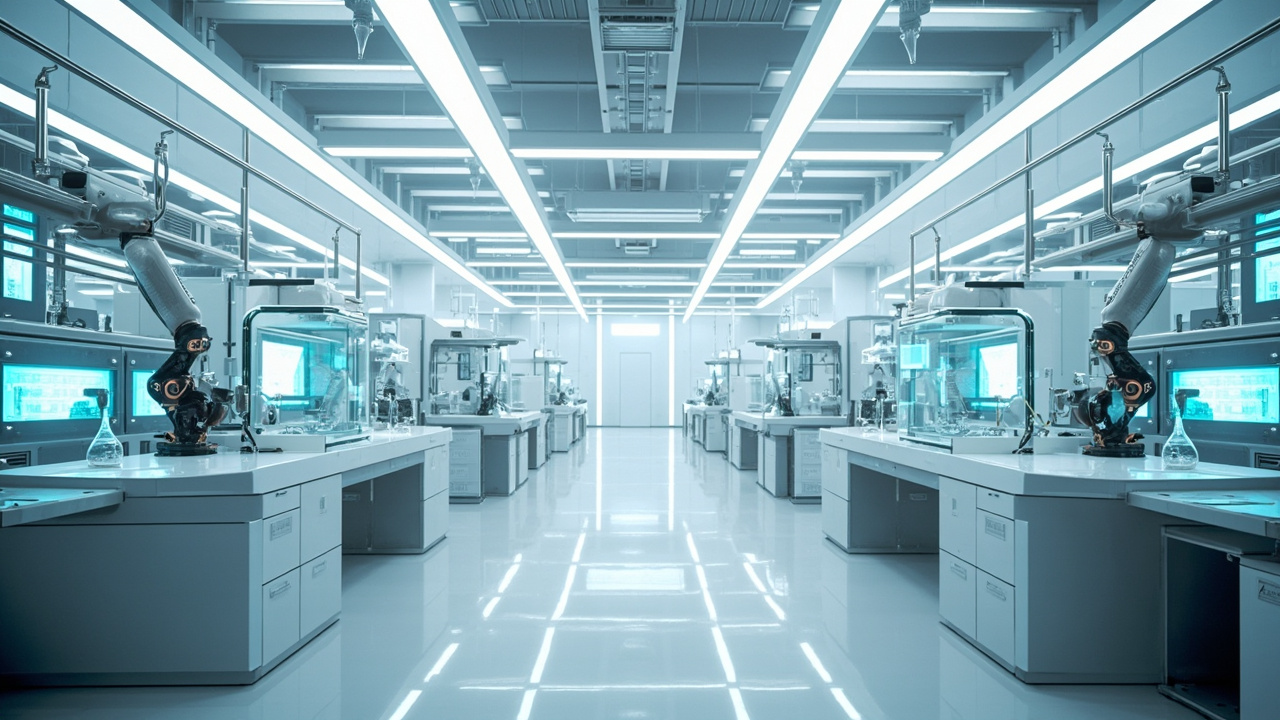
TL;DR: Engineers reported a working design for running hundreds of automated chemistry stations as one coherent laboratory.
Two linked developments published on August 26, 2026 showed how self-driving laboratories move from single robots to infrastructure. A team led by the University of Science and Technology of China described AIchem, a system covering more than 2,600 square meters with 605 registered workstations that has handled more than 10,000 research task dispatches across batteries, catalysis, biochemistry and functional materials, according to ACS Nano. On the same date, Scripps Research reported a $19.5 million award over four years from the U.S. National Science Foundation to build a nationally accessible, fully automated chemistry laboratory with UCLA and Sunthetics, according to Scripps Research.
A scale problem named system entropy
The ACS Nano paper is titled Scientific Engineering of Self-Driving Laboratories at Scale. It was received on August 08, 2026, revision received on August 17, 2026, accepted on August 18, 2026, published online on August 26, 2026, and published in issue on September 08, 2026 as ACS Nano (2026) 20 (35): 24593–24603, according to ACS Nano.
The authors state that scaling self-driving laboratories expands the space of discoverable phenomena. The same expansion increases operational complexity, semantic heterogeneity and decision dependencies, according to ACS Nano. Those increases can erode controllability, interpretability and functional coherence.
The paper defines this scale-induced disorder as system entropy. The team states that it has developed an engineering framework to manage that disorder in AIchem, according to ACS Nano. The publisher is the American Chemical Society.
The funding group listed for the paper is the Chinese Academy of Sciences, according to ACS Nano. The authors declare no competing financial interest, according to ACS Nano. Xiaobo Li and Linjiang Chen contributed equally to the work, while Yi Luo and Jun Jiang supervised the project and coordinated the AIchem platform, according to ACS Nano. All authors contributed to the platform and its implementation, according to ACS Nano.
What AIchem is built to coordinate
AIchem organizes heterogeneous research objects, instruments, computational tools and algorithms into programmable, composable units, according to ACS Nano. That organization uses hardware–software codesign, layered modularity, capability abstraction and skill encapsulation.
Those units are linked by closed-loop task and data flows, according to ACS Nano. The closed loop connects task dispatch with returned data, allowing subsequent tasks to reflect prior results inside the same infrastructure.
The deployment covers more than 2,600 square meters, according to ACS Nano. The deployment includes 605 registered workstations, according to ACS Nano. The stated research domains are batteries, catalysis, biochemistry and functional materials, according to ACS Nano.
The reported use measure is more than 10,000 research task dispatches handled by AIchem, according to ACS Nano. The authors present these deployment and use measures as outlining a practical route for building intelligent research infrastructure at scale, according to ACS Nano.
Who built the AIchem report
The author list names Xiaobo Li, Linjiang Chen, Daobin Liu, Zhuoying Zhu, Xiaolong Zhang, Lulu Guo, Luyao Ge, Huijuan Zhang, Yuebo Liu, Jie Li, Xiaohui Li, Guilin Ye, Yi Luo and Jun Jiang, according to ACS Nano.
Many authors list the State Key Laboratory of Precision and Intelligent Chemistry, Hefei National Research Center for Physical Sciences at the Microscale, School of Chemistry and Materials Science, University of Science and Technology of China, Hefei 230000, China, according to ACS Nano. Many authors also list the Center for Scientific Intelligence Innovation, Hefei 230000, China, according to ACS Nano.
Contact emails listed are [email protected] for Yi Luo and [email protected] for Jun Jiang, according to ACS Nano. ORCID records linked on the page include https://orcid.org/0000-0002-2752-749X for Xiaobo Li and https://orcid.org/0009-0001-1426-1530 for Jie Li, according to ACS Nano.
The article contents list an Abstract and Supporting Information, according to ACS Nano. The Supporting Information is stated to be available free of charge at https://pubs.acs.org/doi/10.1021/acsnano.6c15286, according to ACS Nano. A related record on ACS Figshare states that the item was posted on 2026-08-26, 19:16 and authored by Xiaobo Li, Linjiang Chen, Daobin Liu, Zhuoying Zhu, Xiaolong Zhang, Lulu Guo, Luyao Ge, Huijuan Zhang, Yuebo Liu, Jie Li, Xiaohui Li, Guilin Ye, Yi Luo and Jun Jiang, according to ACS Figshare.
Five videos show the operating software
Supplementary Video 1 shows workflow construction and base-material configuration, according to ACS Nano. The description specifies a silent accelerated recording showing base-material configuration and workflow assembly, corresponding to Figure 3 b, with playback speed 2.5x, according to ACS Nano.
Supplementary Video 2 shows task–product binding, according to ACS Nano. The description specifies a silent accelerated recording showing task–product association used to preserve sample identity and experimental lineage, corresponding to Figure 3 c, with playback speed 1.25x, according to ACS Nano.
Supplementary Video 3 shows dynamic workflow orchestration, according to ACS Nano. The description specifies a silent accelerated recording showing modification of unexecuted downstream workflow steps, corresponding to Figure 3 d, with playback speed 1.5x, according to ACS Nano.
Supplementary Video 4 shows the data center and knowledge repository, according to ACS Nano. The description specifies a silent accelerated recording showing linked task, data and knowledge views corresponding to Figure 3 e,f, with playback speed 2x, according to ACS Nano.
Supplementary Video 5 shows agent-to-platform task dispatch, according to ACS Nano. The description specifies a silent accelerated recording showing an agent request being translated into an AIchem platform task, corresponding to Figures 4 c and 5 d, with playback speed 3x, according to ACS Nano.
A U.S. Chemistry Node joins the same push
In La Jolla, California, Scripps Research announced on August 26, 2026 that a new award from the U.S. National Science Foundation totaling $19.5 million over four years will expand capabilities of its Automated Synthesis Facility, according to Scripps Research. The collaborative effort includes Scripps Research, UCLA and Sunthetics, described as an AI-for-chemistry company, according to Scripps Research.
The project will establish a nationally accessible, fully automated chemistry laboratory called the Chemistry Node, according to Scripps Research. The Chemistry Node will be one of 20 AI-enabled NSF Test Bed: Toward a Network of Programmable Cloud Laboratory nodes across the United States, according to Scripps Research. Those nodes will test, scale and demonstrate new methods and tools that advance automated science and engineering, according to Scripps Research.
The NSF Programmable Cloud Laboratories initiative is led by the NSF Directorate for Technology, Innovation and Partnerships, described as NSF’s newest Directorate in more than 30 years, according to Scripps Research. The Chemistry Node will be housed at Scripps Research’s Automated Synthesis Facility, which provides robotic systems, analytical instrumentation and dedicated staff, according to Scripps Research.
The image credit for the announcement identifies the vial-gripping arm of the Unchained Labs Big Kahuna as the node’s core piece of automation equipment, according to Scripps Research. Credit for that image is given to Scripps Research, according to Scripps Research.
How the Chemistry Node will run experiments
The Chemistry Node aims to advance reaction discovery and optimization by translating researcher ideas into executable experiments, according to Scripps Research. It will run those experiments on robotic infrastructure, analyze results agentically with analytical instrumentation in real time, and then use AI to propose the next set of experiments, according to Scripps Research.
One chemistry problem the node will tackle is optimizing processes for creating specific organic small molecules, according to Scripps Research. Those molecules are often used in medicines, agricultural chemicals and building blocks for new materials, according to Scripps Research.
Some newer methods for making those molecules require multiple catalytic cycles, according to Scripps Research. The announcement compares those cycles to a set of interconnected gears that must spin at well-matched rates to get from input to output, according to Scripps Research. It states that it can be cumbersome to figure out how changing one variable will affect each cycle and their ability to work together, according to Scripps Research. Automation can help make tweaking and assessing those variables more efficient in order to streamline the overall reaction, according to Scripps Research.
Lead principal investigator Brandon Orzolek said the team will progress through multiple phases over the four-year award term while increasing accessibility to the broader community, according to Scripps Research. Orzolek said that by the fourth year, the project should have a closed-loop system that can take an idea from a user anywhere in the world and turn it into an end product, according to Scripps Research. Sunthetics stated that over the four-year project the team will develop a system that can turn a proposed study into an executable experiment, run it with robotic laboratory equipment, evaluate results and recommend what should be tested next, according to Sunthetics.
People, roles and training mission
Brandon Orzolek is the lead principal investigator and scientific director of the Automated Synthesis Facility at Scripps Research, according to Scripps Research. Co-principal investigators are Keary Engle of Scripps Research, Abigail Doyle of UCLA and Daniela Blanco, CEO of Sunthetics, according to Scripps Research and Sunthetics.
Engle will lead catalytic experimental design, according to Scripps Research. Doyle, a professor at UCLA, will direct data-rich experimental design, quality control and academic tool integration, according to Scripps Research and UCLA. Blanco will lead AI integration and web interface development, according to Scripps Research. Sunthetics stated that it will be in charge of the node’s interface to interact with capabilities of all three node partners and will provide its industry-grade platform for AI-driven modeling and experimentation, according to Sunthetics.
Orzolek said the award offers an opportunity to approach synthetic chemistry and its quirks as a data science problem, according to Scripps Research. He said the team unites experts in automation, data and computer science, synthetic chemistry and AI to innovate how chemical information is produced, handled, stored and shared, according to Scripps Research.
Engle is also professor and the John and Susan Diekman Dean of Graduate and Postdoctoral Studies at Scripps Research, according to Scripps Research. Members of Engle’s lab will be among the first to propose experiments and test drive the program, according to Scripps Research.
The node will also serve training, according to Scripps Research. It will provide hands-on learning for students from R2 universities, primarily undergraduate institutions and two-year colleges that may not otherwise have access to advanced research infrastructure, according to Scripps Research. Engle said the program will educate chemists with synthetic chemistry, catalysis, AI and automation research built into their experience, according to Scripps Research.
Decision engines for scarce and noisy data
A review submitted on August 26, 2026 by Yuki K. Wakabayashi and Takuma Otsuka examines Bayesian optimization for self-driving materials laboratories, according to arXiv. The review title is Bayesian Optimization for Self-Driving Materials Laboratories: From Algorithms to Physics-Informed Workflows, according to arXiv.
The review states that self-driving laboratories are transforming materials research by closing the loop among synthesis, characterization, data analysis and experimental decision making, according to arXiv. It describes Bayesian optimization as a decision engine for these loops because it can select experiments from scarce and noisy data while balancing exploitation and exploration, according to arXiv.
The review states that real materials campaigns often depart from the standard black-box setting, according to arXiv. Listed departures include failed or missing experiments, noise and drift, mixed variables, constraints, multiple objectives, variable cost and fidelity, transfer from historical data, batch or asynchronous operation and prior physics knowledge, according to arXiv.
The review summarizes Gaussian-process-based Bayesian optimization and formulation of materials goals as quantitative objectives, according to arXiv. It discusses choices in surrogate modelling and acquisition, according to arXiv. Particular emphasis is placed on physics-informed Bayesian optimization, in which domain knowledge enters through representations, priors, kernels, acquisition functions and constraints, according to arXiv.
The review states that it surveys achievements across semiconductors, catalysis, chemical reactions, batteries, alloys, functional materials and quantum materials, according to arXiv. Highlighted advances beyond parameter optimization include new materials and synthesis routes, improved functional performance and reusable scientific knowledge, according to arXiv. It outlines open problems including nonstationarity, multimodal observations, adaptive problem formulation and scientific reasoning by humans and large language models, according to arXiv.