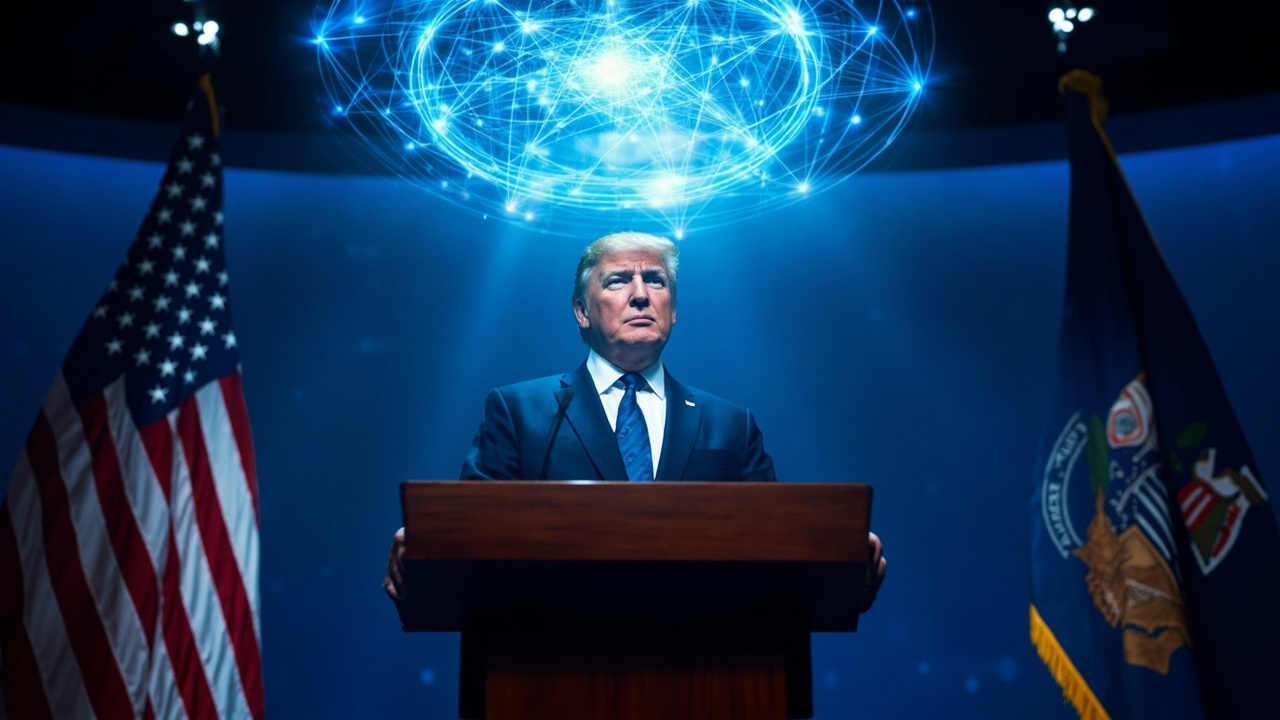
TL;DR: President Donald Trump named Director of National Intelligence Jay Clayton as White House AI czar on Sunday, October 4, 2026, to head a new Super Intelligence Force charged with keeping the United States ahead in advanced AI.
President Donald Trump said on Sunday, October 4, 2026, that Director of National Intelligence Jay Clayton would serve as the administration's AI czar and lead a new White House group called the Super Intelligence Force, according to NPR. Trump announced the choice in a post on Truth Social, writing that the group would ensure American leadership in what he calls Super Intelligence. The move puts the nation's top intelligence official in charge of coordinating federal engagement on AI policy. Clayton will remain as intelligence chief while taking the additional assignment, according to Reuters.
The announcement confirmed reporting from the prior two days that Clayton was expected to get the role. A White House official had told Reuters on October 2 that any personnel announcement would come directly from the president. A separate report by CBS News on October 1 had said Trump was expected to decide shortly and that discussions involved having Clayton keep his intelligence post. The Sunday post ended that period of expectation with a formal designation and a charter-style description of the new panel.
A dual role for the intelligence chief
Clayton oversees 18 U.S. intelligence agencies as Director of National Intelligence, according to Reuters. He was confirmed by the Senate in July 2026 after testifying before the Senate Intelligence Committee on July 15, 2026, according to NPR and Reuters. He was appointed intelligence chief in August, according to Reuters republished by ARN News Centre.
Before leading national intelligence, Clayton served as United States Attorney for the Southern District of New York, according to NPR. Earlier, he chaired the U.S. Securities and Exchange Commission during most of Trump's first term, according to CBS News. NPR also lists both posts as part of his background before confirmation to the intelligence job.
CBS News described Clayton as a lawyer by trade who previously served as the top federal prosecutor in Manhattan and led the SEC. That legal and markets background differs from the venture-capital background of the administration's earlier AI adviser. The choice signals that the White House wants the AI portfolio held by an official already managing classified risk assessments and interagency coordination.
Trump's social-media post did not describe a Senate confirmation process for the czar assignment. The available reporting describes it as an advisory and coordination role inside the White House structure rather than a new cabinet department. According to Reuters, the panel will report to the president and White House Chief of Staff Susie Wiles.
What the Super Intelligence Force is supposed to do
Trump wrote that the Super Intelligence Force, abbreviated SIF, would coordinate federal engagement with consumers, public interest groups, religious organizations, critical infrastructure providers and Super Intelligence companies, according to NPR. In the Truth Social message cited by Reuters, Trump said the group aimed to ensure that America continues to lead the world in Super Intelligence and to protect the interests and improve the lives of all Americans.
Trump prefers the term super intelligence to artificial intelligence, according to NPR. He has used Super Intelligence in recent White House messaging about economic benefits and competitiveness. The new force carries that branding into its formal name.
According to Reuters, Clayton told The Wall Street Journal that the risk of not being first is high. In that interview, cited by Reuters, Clayton said Trump had asked for a group to be assembled to keep the United States at the forefront of advanced AI. The Journal interview was published Saturday, October 3, before Trump's Sunday post.
The task force charter, as described by The Wall Street Journal and summarized by Reuters, gives the group 120 days to produce a report assessing risks and opportunities posed by AI and recommending what role the federal government should play. That deadline would fall in early 2027 if counted from early October. The report is expected to address both opportunity and risk, not regulation alone.
Who else sits on the panel
Trump named three other leaders of the effort in his post, according to NPR and Reuters. They are Federal Trade Commission Chairman Andrew Ferguson, Office of Personnel Management Director Scott Kupor, and Under Secretary of Defense for Research and Engineering Emil Michael. Reuters identified Michael as Pentagon Chief Technology Officer in its summary of the same appointments.
A more detailed roster reported by The Wall Street Journal and summarized by Reuters republished by ARN News Centre lists Michael, Kupor and Ferguson as vice chairs. That account also lists as members Vice President JD Vance, Defense Secretary Pete Hegseth, Treasury Secretary Scott Bessent and White House Chief of Staff Susie Wiles. The same account lists external advisers as including venture capitalist David Sacks and former Secretary of State Condoleezza Rice.
The structure therefore combines White House staff, economic and personnel agencies, defense technology leadership, and competition regulators. The inclusion of the FTC chairman connects the effort to consumer protection and competition oversight. The inclusion of the personnel office connects it to federal hiring and workforce questions. The defense research chief connects it to national-security applications.
It remains unclear from the published posts how often the full group will meet or whether vice chairs will manage day-to-day work. What is established in the sources is the leadership list and the reporting line to Trump and Wiles. No additional budget or staffing figure was disclosed in the reporting available by October 4.
A 120-day study of risk and federal response
Clayton said the task force would have 120 days to research and report on risks and opportunities and to offer recommendations on federal responsibilities, according to reporting summarized by Reuters. The study will review AI-related risks and current government reporting mechanisms for breaches, hacks and other incidents, according to Reuters citing the task force charter described by The Wall Street Journal.
The panel is also expected to recommend ways to strengthen federal response capabilities under existing authorities, according to the same charter summary. That phrasing matters because Congress has not passed a broad federal AI law. Recommendations framed around existing authorities would operate within current agency powers rather than assuming new legislation.
Safety concerns cited in recent coverage include warnings from some researchers that builders of the technology believe it could cause severe harm within a decade, according to Reuters. Several Democratic and Republican lawmakers have responded with alarm and calls for more action, according to the same report. The 120-day review is positioned as the administration's vehicle for sorting those claims and proposing a federal posture.
Clayton previewed his view in a CNBC interview last month, according to NPR. He called super intelligence a national security issue and rejected calls for a pause in development. He argued that other countries are continuing to develop AI and said he did not think Americans should view a pause as a good strategy. That stance aligns with Trump's emphasis on maintaining a lead over China.
Tuesday summit set the stage
On Tuesday, September 29, Trump met at the White House with AI executives and said afterward that leaders of several AI companies had signed a voluntary accord that will include internal and external reviews of their work, according to NPR. CBS News reported that the meeting involved leaders of the country's top AI firms and centered on voluntary safety standards.
CBS News identified participants as including OpenAI, Anthropic, Google, Meta, Nvidia and Elon Musk's SpaceXAI. Trump called the agreement morally binding and almost like a constitution, according to CBS News. He said he was seeing tremendous self-policing and that companies understand they have to self-police.
The accord involves several layers of internal controls and external audits to ensure models work as intended, according to CBS News. It does not create a new federal regulation by itself. Instead, Trump presented it as a commitment device backed by reputational and moral pressure.
Trump had previewed the czar pick shortly after that meeting, according to CBS News. He told reporters he planned to name an AI czar within three or four days and said the choice would be somebody extraordinary. Last month he had posted on social media about plans to name an AI czar, writing that only high-IQ individuals need apply, according to CBS News. The Sunday Clayton announcement followed that timeline.
Light-touch regulation and China competition
Trump has appeared to favor a light touch toward AI regulation, arguing that excessive oversight could weaken competitiveness against China, according to Reuters. He said on Tuesday that he does not want to work with Chinese President Xi Jinping on governing AI technology, according to the same report. That position frames AI governance as a national competition issue rather than a joint international project.
Trump has largely brushed aside warnings that AI could go rogue and has tried to reframe concerns around AI, according to NPR. He touts economic benefits of the technology and argues a slowdown could give Chinese labs an edge, according to CBS News. He has said federal law enforcement can deal with bad actors, according to the same report.
That skepticism toward tighter rules was echoed in recent industry debate covered by CBS News. Anthropic CEO Dario Amodei and OpenAI CEO Sam Altman have backed pacing frontier development to manage risks, while investor David Sacks and Nvidia CEO Jensen Huang have argued some grave warnings are overblown. Trump is aligned in that debate with the camp warning against slowing U.S. labs.
The White House also launched a revamped government website this week, America.gov, which says it is sourced via artificial intelligence from official government sources, according to NPR. The launch illustrates the administration's public embrace of AI-generated summaries for citizen-facing information even as it studies risks behind the scenes.
Limited federal rules, active states
It is unclear what Clayton's appointment means for industry practice because current federal regulation of AI is limited, according to NPR. Congress has not passed federal law broadly regulating the use or development of AI, according to the same report. Some states, including California, have enacted measures about AI, including requiring transparency when it is used.
That gap helps explain why the new force is starting with a risk-and-opportunity assessment rather than a rule proposal. Without a comprehensive statute, agencies rely on sectoral authorities covering consumer protection, securities disclosure, communications, defense procurement and other domains. The charter's reference to existing authorities points toward mapping those tools before recommending changes.
The review of reporting mechanisms for breaches and hacks could become the most concrete technology item. Federal incident-reporting rules already exist in cybersecurity and critical infrastructure, but AI-specific failure modes such as agent misbehavior or model-enabled intrusions may not fit neatly into those channels. The task force is charged with examining whether current channels capture AI incidents and how federal response should adapt.
No draft legislation was attached to the Sunday announcement. No executive order text was quoted in the sources available by October 4. For technology teams, the near-term signal is process and personnel, not a new compliance deadline.
From Sacks to Clayton
This is the second time Trump has named an adviser to oversee AI-related decisions across the administration, according to Reuters. Venture capitalist David Sacks held the AI czar role at the beginning of Trump's second term, according to the same report. In December 2024, President-elect Trump announced he would appoint Sacks, a Silicon Valley investor, as AI and crypto czar to advise on policy, according to NPR.
Earlier in 2026, Sacks stepped down from that role and became co-chair of the President's Council of Advisors on Science and Technology, according to NPR. CBS News reported that he stepped down earlier this year but continued to co-chair the council. The council draws on outside experts on technology and science policy.
Sacks has backed warnings from Amodei and Altman about the technology and the idea of slowing development, according to NPR. Last month, Sacks wrote on social media that tech leaders should stop pretending they need anyone else's permission to take safety steps, according to the same report. His continued presence as an external adviser to the new force, as reported by the Journal summary, would keep that perspective in the room alongside Clayton's national-security framing.
The shift from an investor-adviser to the sitting intelligence chief marks a change in institutional weight. Sacks operated as an outside adviser. Clayton arrives with control of intelligence collection and analysis and a direct line to the president's daily briefing process. For AI labs, that could mean questions about capabilities, security practices and foreign linkages receive more structured government attention.
What to watch next
The first test will be whether the 120-day report arrives with specific recommendations that agencies can adopt without new law. Watch for proposals on incident reporting, evaluation standards, procurement guidance and coordination with critical-infrastructure operators. Those are areas where existing authorities are strongest and where the charter explicitly directs attention.
The second test will be how the force engages outsiders. Trump's post lists consumers, public-interest groups, religious organizations, infrastructure providers and AI companies as interlocutors, according to NPR. External advisers named in the Journal summary include Sacks and Rice. The balance among those voices will shape whether the review emphasizes deployment benefits, safety constraints or geopolitical competition.
The third test will be transparency. The administration has just promoted AI-sourced summaries on America.gov while asking industry to accept external audits of frontier models. Whether the Super Intelligence Force publishes its evidence base, meeting records or evaluation criteria will affect how researchers and state regulators interpret its conclusions. None of those publication plans were detailed in the material available by October 4.
Sources referenced
- Trump names national intelligence chief Jay Clayton as new AI czar : NPR (https://www.npr.org/2026/10/04/nx-s1-5990781/jay-clayton-ai-czar-trump)
- Trump names intelligence chief Clayton as AI czar, to head task force - Reuters via StreetInsider (https://www.streetinsider.com/Reuters/Trump+names+intelligence+chief+Clayton+as+AI+czar%2C+to+head+task+force/27144334.html)