TL;DR: Ten teams won 2026 Ig Nobel Prizes in Zurich on September 3, 2026, for research that first amuses and then provokes thought, from splash-free urinals to buried underwear.
Ten research teams were honored Thursday at a satirical science awards ceremony in Zurich, Switzerland, on September 3, 2026, in the first Ig Nobel ceremony held outside the United States after 35 years in Boston, according to the Associated Press in reporting carried by PBS News.
The move ended a long run at Harvard University, the Massachusetts Institute of Technology and Boston University, and reflected concern about visas and travel for international guests, according to the Associated Press in reporting carried by PBS News. The 36th First Annual Ig Nobel Prize ceremony took place at the Zurich Convention Center, according to Improbable Research. The prizes, established in 1991, honor achievements that first make people laugh and then make them think, according to Ars Technica in "Meet the 2026 Ig Nobel Prize winners."
Organizers plan to alternate future ceremonies between Zurich and other European countries, with the 2027 ceremony in Antwerp in Belgium and a return to Zurich in 2028 and every even-numbered year after that, according to Ars Technica in "Meet the 2026 Ig Nobel Prize winners" and the Associated Press in reporting carried by PBS News. The theme for the 2026 event was fungi, according to CNN, and each winner received a custom trophy resembling a cross between a mushroom and a human foot, according to the Associated Press in reporting carried by PBS News. NPR described the statuette as a slab of blue cheese topped by a foot erupting with toadstools in honor of the broader theme of fungi.
Why the ceremony left Boston after 35 years
For the first time in the ceremony's 35-year history, officials held the Ig Nobel ceremony outside the United States, in Zurich, Switzerland, according to NPR. Marc Abrahams, who founded the Ig Nobels in 1991 and serves as master of ceremonies and editor of The Annals of Improbable Research magazine, said travel conditions had changed for international participants, according to Ars Technica in "Meet the 2026 Ig Nobel Prize winners" and NPR.
Four of last year's 10 winners opted to skip the ceremony rather than travel to the United States, and organizers said the situation had not improved, according to Ars Technica in "Meet the 2026 Ig Nobel Prize winners." Abrahams told The Associated Press in March that during the past year it had become unsafe for guests to visit the country and that organizers could not in good conscience ask new winners or international journalists to travel to the United States that year, according to Ars Technica in "Meet the 2026 Ig Nobel Prize winners."
NPR reported that four winners the previous year did not want to travel to the United States, citing safety concerns related to unpredictable immigration and visa protocols. Abrahams said before the prior year almost every winner would find a way to travel to the ceremony from around the world, but the prior year only six of 10 appeared, according to NPR. Kees Moeliker, retired director of the Natural History Museum Rotterdam and a former Ig Nobel winner, called the move sad because it left where it started but also positive because it opened new horizons and new audiences in Europe, according to NPR.
Holden Thorp, editor-in-chief of the Science family of journals, who does not play a role in the Ig Nobels, said the decision to hold the ceremony outside the United States was rational and reflected a broader trend in which international scientists were less enthusiastic about coming to the United States for study, work and awards, according to NPR. Thorp said a principle by which the United States built scientific excellence was welcoming scientific talent from around the world, and that was no longer the case, according to NPR.
How the campy night works
The unapologetically campy awards ceremony features miniature operas, scientific demos, and 24/7 lectures, whereby experts must explain their work twice, once in 24 seconds and the second in just seven words, according to Ars Technica in "Meet the 2026 Ig Nobel Prize winners." Acceptance speeches are limited to 60 seconds, according to Ars Technica in "Meet the 2026 Ig Nobel Prize winners."
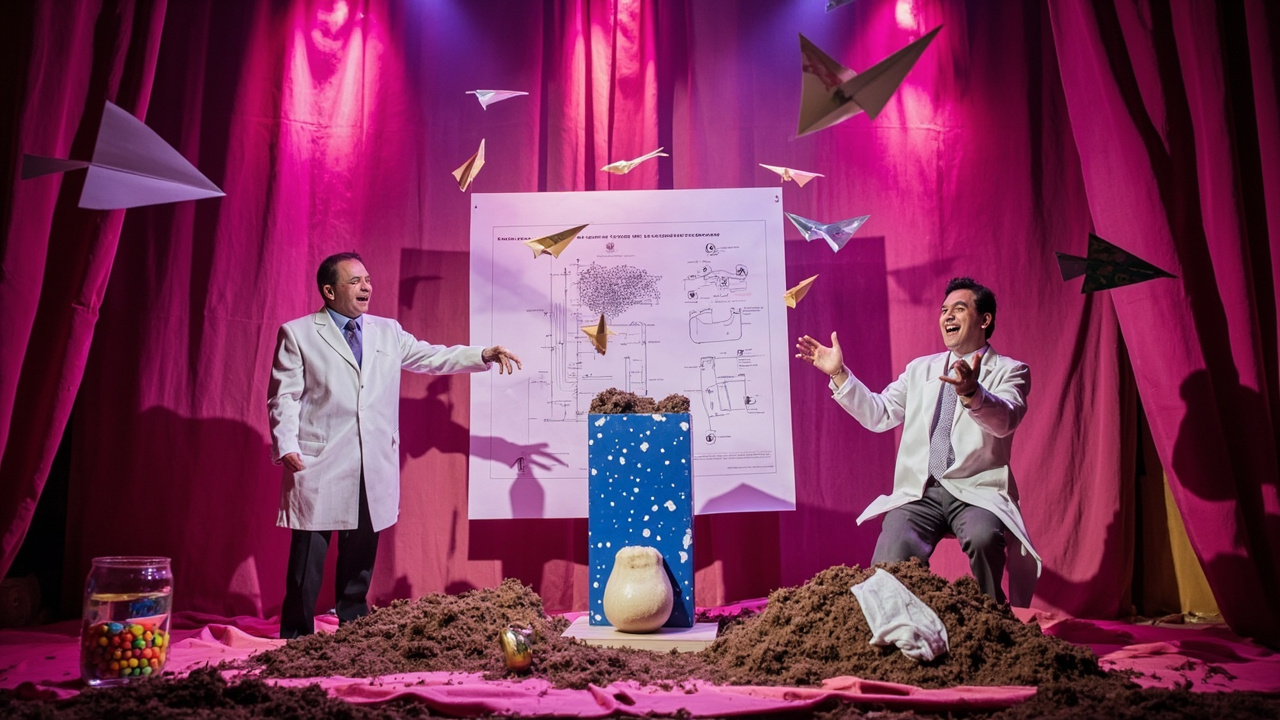
As per tradition, audience members fashioned paper airplanes and hurled them toward the stage to kick off the show, according to the Associated Press in reporting carried by PBS News. Audience members toss paper airplanes during Ig Nobel ceremonies, according to NPR. In the weeks following the ceremony, the winners will also give free public talks, which will be posted on the Improbable Research website, according to Ars Technica in "Meet the 2026 Ig Nobel Prize winners."
All winners received 10 trillion Zimbabwean dollars, but that currency cratered years ago, so it is not actually worth anything, according to NPR. The Guardian described the prize as leaving winners with a 10tn dollar note. Abrahams said the goal was to get people interested in things that otherwise they might never let themselves become interested in, according to NPR. The Nobel Prizes, which have no relation to their cheekily named counterpart, will be announced at the start of October, according to the Associated Press in reporting carried by PBS News.
Biomechanics: what counts as a kiss
The Biomechanics Prize went to Matilda Brindle and Stuart West from the University of Oxford and Catherine F. Talbot from the Florida Institute of Technology, who reconstructed the evolutionary history of kissing, according to the Associated Press in reporting carried by PBS News. The citation honored Brindle, Talbot and West for devising a more precise definition of kissing in ants, birds, polar bears and humans, according to Ars Technica in "Meet the 2026 Ig Nobel Prize winners."
The definition was framed as non-agonistic interactions involving directed, intraspecific, oral-oral contact with some movement of the lips or mouthparts and no food transfer, according to NPR and Ars Technica in "Meet the 2026 Ig Nobel Prize winners." Brindle is an evolutionary biologist at the University of Oxford, according to NPR and ABC News. The team argued that an earlier approach that defined kissing as involving protruded lips and suction movement merely described physical movements common to human beings and was not helpful from an evolutionary standpoint, according to Ars Technica in "Meet the 2026 Ig Nobel Prize winners."
The researchers preferred a less anthropocentric definition because some form of mouth-to-mouth contact can be seen across the animal kingdom, while excluding mouth-to-mouth feeding behavior or dogs licking owners' lips, according to Ars Technica in "Meet the 2026 Ig Nobel Prize winners." Polar bears tongue, prairie dogs gently smooch and insects suck face under that broad approach, according to ABC News. Brindle said the team needed a broad definition that was also narrow enough to exclude behaviors that look like kissing but are not, according to ABC News.
With that definition in hand, the authors concluded that most large apes engage in some form of kissing, although they lacked data to determine how many times kissing evolved in Afro-Eurasian monkeys and apes, according to Ars Technica in "Meet the 2026 Ig Nobel Prize winners." Eastern gorillas seem to have lost that evolutionary feature at some point, according to Ars Technica in "Meet the 2026 Ig Nobel Prize winners." The authors concluded that Neanderthal ancestors also engaged in kissing, according to Ars Technica in "Meet the 2026 Ig Nobel Prize winners."
Brindle said that to understand how a trait evolved, researchers cannot look at one species alone but must look across different species, according to NPR. The team found that kissing occurs in most living large apes and likely in Neanderthals, and argued that early humans and Neanderthals may have kissed one another, according to NPR. Brindle described the work as putting a romantic spin on human-Neanderthal relationships and as a 21.5 million-year-old tradition, according to NPR. ABC News reported that understanding such behaviors has consequences for understanding the evolution of reproductive strategies and human sexuality.
The researchers noted some evidence that kissing in a sexual context may increase mating success, and that every species in which kissing evolved also engages in premastication, according to Ars Technica in "Meet the 2026 Ig Nobel Prize winners." Why and how kissing evolved will be the subject of future research, according to Ars Technica in "Meet the 2026 Ig Nobel Prize winners." The possible functions include facilitating mate choice or exchanging beneficial oral microbes, according to NPR.
Economics: upper-class drivers and children's candy
The Economics Prize went to Paul Piff, Daniel Stancato, Stephane Cote, Rodolfo Mendoza-Denton and Dacher Keltner for amassing evidence that upper-class people are more likely to snatch from a children's supply of candy and engage in other kinds of unethical behavior, according to Ars Technica in "Meet the 2026 Ig Nobel Prize winners." The group found that those in higher social classes were more likely to take from a children's candy stash, according to NPR.
Volunteers were left alone with a jar of sweets ostensibly meant for children, and when researchers returned, upper-class people had taken far more, according to The Guardian. Study participants were offered a jar of candies which they were told was intended for children in another lab, as a test of entitlement, according to Ars Technica in "Meet the 2026 Ig Nobel Prize winners" and ABC News. The Guardian summarized the roundup as showing rich people more likely to steal children's sweets.
The authors conducted seven related studies to examine social status and unethical behavior from multiple angles, according to Ars Technica in "Meet the 2026 Ig Nobel Prize winners." One field study assessed whether upper-class drivers, as judged by the type of car driven, were more or less likely to cut off other vehicles at a busy four-way intersection, according to Ars Technica in "Meet the 2026 Ig Nobel Prize winners." Another looked at whether such drivers were more likely to cut off pedestrians at a crosswalk, according to Ars Technica in "Meet the 2026 Ig Nobel Prize winners."
Again and again, the upper-class participants proved more likely and willing to engage in various kinds of unethical activity, whether cutting off cars or pedestrians, taking candy, or lying about scores in random dice rolls, according to Ars Technica in "Meet the 2026 Ig Nobel Prize winners." Upper-class people did not come out well in the large 2012 study, which also found they were more likely to break the law while driving, lie in a negotiation and cheat to win a prize, according to ABC News. They were also more likely to view greed as a positive attribute, according to Ars Technica in "Meet the 2026 Ig Nobel Prize winners."
The authors acknowledged exceptions, including philanthropic and ethical wealthy individuals, according to Ars Technica in "Meet the 2026 Ig Nobel Prize winners." The researchers suggested increased privacy of upper-class jobs, extra money to deal with consequences if caught and a feeling of entitlement could have contributed, according to ABC News. They concluded that the pursuit of self-interest was a more fundamental motive among society's elite and that increased want associated with greater wealth and status can promote wrongdoing, according to ABC News.
Physics: building a splash-free urinal
This year's physics prize was awarded to a research group that built the theory around and then prototyped a splash-free urinal, according to NPR. The prizes honored research on designing the perfect splash-free urinal, according to Ars Technica in "Meet the 2026 Ig Nobel Prize winners." Tadd Truscott, a fluid dynamicist at the King Abdullah University of Science and Technology in Saudi Arabia and a member of the winning team, worked on fluid mechanics for the project, according to NPR.
Truscott said people who have worn sandals at a urinal sometimes feel droplets that could be their own or a neighbor's, and the idea was to stop that completely, according to NPR. Truscott helped determine the optimal stream angle to minimize splashback, which is less than 30 degrees, according to NPR. His colleagues then redesigned a urinal so that any direction of urination maintains that minimum angle so there is always no splash, according to NPR.
When Truscott got the news of the Ig Nobel, he said he almost passed out from excitement, according to NPR. The work moved from theory to a prototype that sought to maintain the low impact angle in ordinary use, according to NPR and Ars Technica in "Meet the 2026 Ig Nobel Prize winners."
Soil science: 1,000 pairs of buried underwear
The Soil Science Prize went to European researchers for buried cotton underwear used to test soil health, according to ABC News. The team got 1,000 citizen scientists to plant cotton underwear across more than 25 countries to test soil health in local areas, according to ABC News. Another research team buried 1,000 pairs of underwear in more than 25 countries to study how critters in the soil helped them decompose, according to the Associated Press in reporting carried by PBS News.
Soil Science Prize winners Pia Viviani and Atlant Bieri appeared on stage during the ceremony at the Zurich Convention Center, according to the Associated Press. Marcel van der Heijden, an agroecologist at the University of Zurich, said the goal was to make people aware of the importance of soil, according to ABC News. He said the team explores soil biodiversity and the importance of soil life for plant growth and ecosystem functioning, according to ABC News.
The team wanted to bring that work closer to the general public and started burying underpants to visualize soil processes, according to ABC News. The researchers found that the type of land use, including garden, meadow, field or lawn, is a key factor in decomposition of underwear, according to ABC News. The buried cotton underwear decomposed faster in soil with higher fertility and more nutrients, according to ABC News. They proposed an underwear index using a decomposition percentage to measure soil health in an easy-to-understand way, according to ABC News.
Medicine, chemistry and engineering highlights
A late researcher who examined the aerodynamics of nose blowing received the medicine award, according to NPR. The late Dr. Tokuji Unno investigated the science of blowing one's nose, according to the Associated Press in reporting carried by PBS News. The prizes also highlighted the aerodynamics of a healthy nose-blow, according to Ars Technica in "Meet the 2026 Ig Nobel Prize winners."
Researchers who studied milk from cockroaches received Ig Nobel prizes celebrating unusual and imaginative contributions to science, according to the Associated Press in reporting carried by PBS News. The prizes also honored using mosquito proboscises to necroprint tiny nozzles, according to Ars Technica in "Meet the 2026 Ig Nobel Prize winners." That mosquito work connected insect anatomy to fabrication of very small nozzles through a process described as necroprinting, according to Ars Technica in "Meet the 2026 Ig Nobel Prize winners."
Around the world, scientists work in less stereotypical environments on unusual projects, such as gently stepping on different parts of a venomous snake to work out what will make the animal bite a human, according to CNN. That snake-stepping study was one of 10 pieces of research honored Thursday at the awards, according to CNN. The awards exist to shine a spotlight on scientific achievements that first make people laugh and then make them think, according to CNN.
Peace: why we want vicious friends
Keelah Williams, an evolutionary psychologist at Hamilton College and an Australia-United States dual citizen, and colleagues won the Ig Nobel Peace Prize for work on the surprising trait people want in friends, according to ABC News. Williams said she could not believe it when she got the phone call announcing the prize and called it a very exciting moment, according to ABC News.
The paper found that while people want friends to be kind and helpful, that is not the whole story, according to ABC News. Williams said people want friends to be kind, helpful, generous and lovely, but also want friends who would happily confront an ex if they had the chance, according to ABC News. She said the puzzle was how to reconcile those two wishes, according to ABC News.
The researchers found that people want friends who are kind and generous toward them, not necessarily toward other people, especially people they do not like, according to ABC News. The work framed loyalty as fiercely favoring one's own friends even when someone is unkind to outsiders, according to ABC News.
What the winners take home
This year, 10 prizes were awarded at the ceremony in Zurich, the first time in 36 years the Ig Nobels had been hosted outside the United States, according to ABC News. Ten research teams were honored Thursday at the satirical ceremony, according to the Associated Press in reporting carried by PBS News. The annual awards play on the coveted Nobel Prizes and are given for research that first makes people laugh and then makes them think, according to ABC News.
In past years, work such as a citizen-science investigation into belly button lint had won awards, according to ABC News. In 2025, the Physics Ig Nobel Prize went to European researchers who studied the behavior of cacio e pepe pasta sauce, according to NPR. Next year's ceremony will be held in Antwerp, Flanders, and the Ig Nobels will return to Zurich in 2028 and every even-numbered year after that, in a pattern Abrahams compared to the Eurovision Song Contest with a base in Europe, according to Ars Technica in "Meet the 2026 Ig Nobel Prize winners."
Sources referenced
- Meet the 2026 Ig Nobel Prize winners - Ars Technica (https://arstechnica.com/science/2026/09/meet-the-2026-ig-nobel-prize-winners/)
- Kissing apes, anti-splash urinals: This year's Ig Nobels showcase surprising science : NPR (https://www.npr.org/2026/09/03/nx-s1-5950370/ig-nobel-awards-kissing-urinals-move-switzerland)