TL;DR: Stanford psychiatrist Karl Deisseroth shared the 2026 Nobel Prize in Physiology or Medicine for optogenetics, then paused celebration to pack school lunches.
A midnight call in Stanford
Dr. Karl Deisseroth spent hours taking congratulatory calls early Monday after learning he had won the Nobel Prize for medicine, according to The Associated Press.
The calls began in the middle of the night at the family home in Stanford, California, where his children were asleep while he spoke with journalists and well-wishers, according to The Associated Press.
The 54-year-old Howard Hughes Medical Institute investigator and Stanford University professor soon asked for a pause in the attention for a routine family job, according to The Associated Press.
He needed to make school lunches for his children, who were asleep in the home, according to The Associated Press.
A self-described night owl, Deisseroth often works past midnight, according to The Associated Press.
After reviewing papers and emailing his students, he said he had just gone to lie down when the call arrived from the Nobel Assembly in Stockholm, according to The Associated Press.
“I almost felt as if I’d lost the power of forming words,” he told The Associated Press, “but I recovered after a minute or two.”
He regained speech quickly enough for remote interviews with AP science reporters, according to The Associated Press.
Speedy emails with Stanford communications staff had helped put them in touch, according to The Associated Press.
“No real sleep was achieved,” he said an hour after the announcement, according to The Associated Press.
As the science reporters spoke with Deisseroth over phone and Zoom, an AP photographer and videographer raced to his home in Stanford, according to The Associated Press.
One light on, Halloween outside
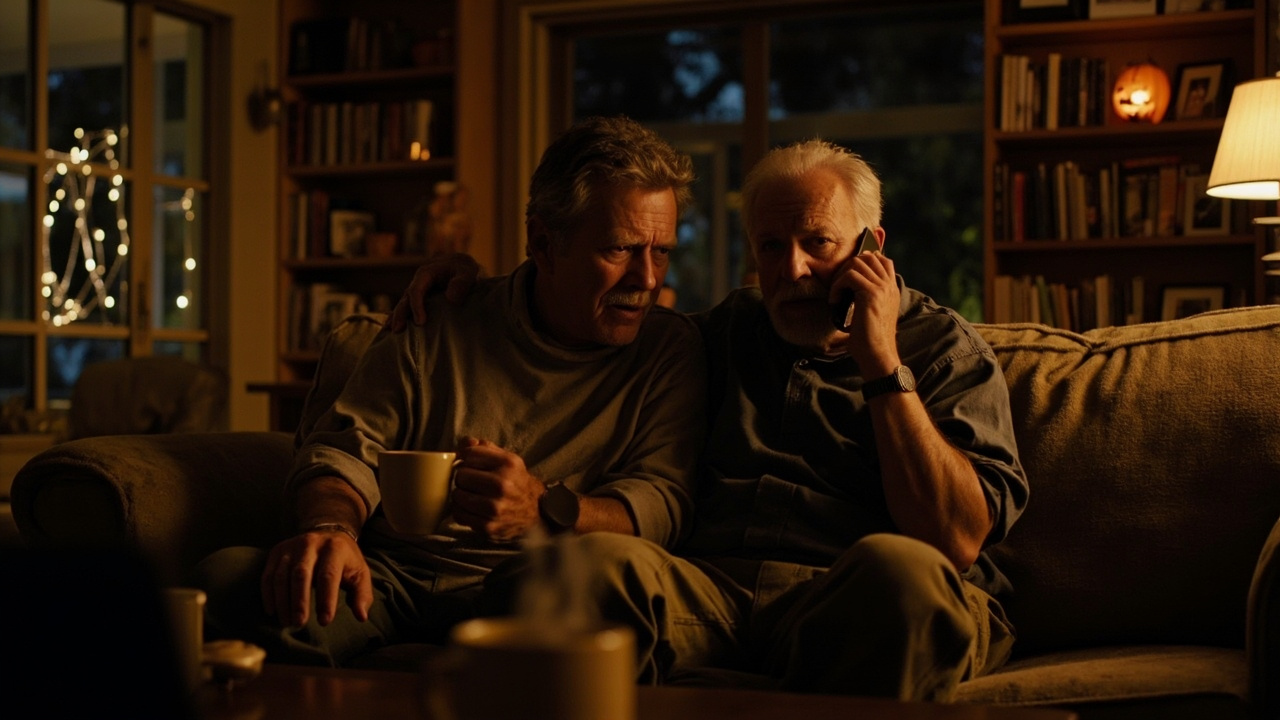
The photographer arrived around 3:30 a.m. to find Halloween decorations outside the home but just one light on inside, according to The Associated Press.
He was worried he had the wrong house before mustering the courage to knock on the door, according to The Associated Press.
Dr. Michelle Monje-Deisseroth, the scientist’s wife, answered and ushered the photographer into their home, according to The Associated Press.
Inside, the Nobel winner was taking calls from the couch, according to The Associated Press.
Monje-Deisseroth, an HHMI investigator and Stanford pediatric neuro-oncologist, was at his side when she was not making coffee for the Stanford communications staff who had joined the celebration, according to The Associated Press.
Deisseroth said he was surprised to hear his work had been honored with a Nobel Prize, but his wife was not, according to The Associated Press.
Stanford Report added detail on the timing of the Stockholm call, reporting that the call from the Nobel committee came in at 12:27 a.m. Pacific Time.
Deisseroth missed that first call, according to Stanford Report.
Seconds later, the phone of his wife, Michelle Monje-Deisseroth, rang, with one simple question on the other end: “May we speak with Karl?” according to Stanford Report.
The first and only call he made afterward was to his mom, according to Stanford Report.
In a living room lined with shelves of books and family photos of the couple and their five still sleeping children, Deisseroth fielded call after call from reporters, according to Stanford Report.
He sipped from a mug that read, “That’s what I do. I drink and I know things,” according to Stanford Report.
That line is a quote from the television series Game of Thrones, of which the couple are big fans, according to Stanford Report.
Monje-Deisseroth was quick to clarify that what he drinks is coffee, and that he does, in fact, know things, according to Stanford Report.
Why the prize was awarded
The Nobel Prize in medicine was awarded Monday to three scientists whose work led to a tool that uses light to help unravel how the brain works, according to The Associated Press.
Karl Deisseroth, Peter Hegemann and Georg Nagel carried out research into light-gated ion channels and optogenetics, according to The Associated Press.
On Oct. 5, 2026, the Nobel Assembly at Karolinska Institutet decided to award the 2026 Nobel Prize in Physiology or Medicine jointly to the three men, according to NobelPrize.org.
Deisseroth was identified as affiliated with the Howard Hughes Medical Institute and Stanford University in the United States, according to NobelPrize.org.
Hegemann was identified with Humboldt University of Berlin in Germany, according to NobelPrize.org.
Nagel was identified with the University of Würzburg in Germany, according to NobelPrize.org.
The award cited “their discoveries concerning light-gated ion channels and optogenetics,” according to NobelPrize.org.
The Nobel Assembly said their tool is now being used in research on the brain, according to The Associated Press.
The prize amount is 12 million Swedish kronor, to be shared equally between the laureates, according to NobelPrize.org.
Reuters also reported Oct. 5, 2026, that American Karl Deisseroth and Germans Peter Hegemann and Georg Nagel won the prize for developing optogenetics, a technique that uses light to control individual nerve cells in the brain.
The Nobel Assembly listed Deisseroth as 54, Hegemann as 71, and Nagel as 73 in its selection for discoveries concerning light-gated ion channels and optogenetics, according to Reuters.
What optogenetics does
Deisseroth shared this year’s medicine prize with two researchers in Germany for their work in optogenetics, a field that combines light with genes to switch on and off neurons in living brains, according to The Associated Press.
The 2026 prize was awarded for optogenetics — a method that makes it possible to show how nerve cells shape memories, feelings and behaviours in the living brain, according to NobelPrize.org.
Peter Hegemann and Georg Nagel discovered a remarkable protein, channelrhodopsin, in a single-celled alga, according to NobelPrize.org.
Karl Deisseroth transformed the protein into a light-controlled switch for nerve cells, according to NobelPrize.org.
The laureates have laid the foundation of a new era in neuroscience, according to NobelPrize.org.
How the brain governs feelings, behaviours and bodily functions has long been a mystery, according to NobelPrize.org.
In the 20th century, researchers began to investigate which areas of the brain affect which functions, but the methods used meant they could not prove causal relationships, according to NobelPrize.org.
The image they developed of the brain was like a sketch map, full of question marks and unknowns, according to NobelPrize.org.
“Optogenetics provides opportunities for mapping the brain in a way that we could once only dream of,” said Per Svenningsson, Chair of the Nobel Committee for Physiology or Medicine, according to NobelPrize.org.
Stanford Report described Deisseroth’s role as developing a process to insert light-sensitive microbial proteins called opsins into mammalian brain cells, allowing selected cells to be controlled by light.
The Stanford award citation said the discoveries make it possible to switch on, or off, the activity of individual nerve cells in a living brain, according to Stanford Report.
“I couldn’t be happier because the trio that the committee picked spans the progression from the early algal explorations all the way to advanced neuroscience experiments, so this prize really captures the full journey of discovery,” Deisseroth said, according to Stanford Report.
From pond algae to brain cells
It all began with Peter Hegemann’s curiosity, according to NobelPrize.org.
He wondered how Chlamydomonas, a single-celled alga, is able to swim towards a light source, according to NobelPrize.org.
In the early 2000s, he and Georg Nagel discovered channelrhodopsin, an algal protein with unique properties, found on the surface of the cell, according to NobelPrize.org.
When it is illuminated by blue light, a channel opens through the protein, according to NobelPrize.org.
Charged ions then flow into the cell, creating an electrical impulse, according to NobelPrize.org.
They found that regardless of which cell they put the protein in, those cells became light sensitive, according to NobelPrize.org.
Karl Deisseroth introduced the gene for channelrhodopsin into nerve cells from rats, according to NobelPrize.org.
By illuminating the cells with blue light, he was able to trigger a nerve signal, according to NobelPrize.org.
He published this breakthrough in 2005, according to NobelPrize.org.
Two years later, he made this light-controlled switch for nerve cells work in the brains of living mice, according to NobelPrize.org.
This method for controlling nerve signals with light is now called optogenetics, and it has rapidly gained global impact, according to NobelPrize.org.
Before the advent of optogenetics, there were two main experimental workhorses for studying the brain: electrical stimulation and drugs, according to Stanford Report.
Exciting neurons by stimulating them electrically elicits an immediate response, but also trips off responses in neighboring cells, according to Stanford Report.
“Optogenetics is an engine for discovery,” Deisseroth said, according to Stanford Report. “It’s for probing complex systems at the fundamental level of cells.”
He added that researchers want to understand how the brain works as an intact system to carry out complex cognitions, behaviors, and perceptions while being anchored at the elemental cellular level, according to Stanford Report.
Patients, memories and sight
Using optogenetics, researchers have been able to reveal neural circuits governing specific memories, feelings, and behaviours relevant for neurological and psychiatric disorders, according to NobelPrize.org.
In clinical medicine, researchers are using the method in attempts to restore sight in people with visual impairment, according to NobelPrize.org.
Deisseroth recounted the research he conducted with fellow Nobel winners Peter Hegemann and Georg Nagel, and its real-world impact, according to The Associated Press.
“For me, I’m a physician-scientist. I am a psychiatrist. I care about patients and my patients who have autism, who have depression,” he said, according to The Associated Press. “I care about the hope that this brings.”
“But I’m also a basic scientist, and I care about understanding this amazing organ, the brain, and how it works and how it integrates and computes and delivers all the things that make us human,” he said, according to The Associated Press.
Deisseroth established his prominence as a leader in neuroscience by developing the process for light-sensitive control of mammalian brain cells, according to Stanford Report.
Stanford University President Jonathan Levin said Deisseroth is a defining figure in modern neuroscience and that he and his fellow laureates have unlocked new understanding of how the brain works and created new possibilities for treating neurological and psychiatric disorders, according to Stanford Report.
Lloyd Minor, dean of Stanford’s School of Medicine, said Deisseroth’s creativity and ability to bridge disciplines have given scientists powerful new tools to unravel the brain and brought hope to patients and families worldwide, according to Stanford Report.
Jennifer Widom, dean of Stanford’s School of Engineering, said the prize reflects an approach combining engineering precision with curiosity and compassion, according to Stanford Report.
“I’m just so delighted. I know I’m biased, but he’s really transformed the field of neuroscience – and actually several other fields,” said Monje-Deisseroth, the Milan Gambhir Professor in Pediatric Neuro-Oncology at Stanford Medicine, according to Stanford Report.
“I was quite surprised,” Deisseroth said of the recognition, according to Stanford Report. “I found I had a hard time speaking – I lost the ability to form words for about 30 seconds or so.”
Training, writing and psychiatry
Although his parents were both trained as scientists, with his father in oncology and his mother in chemistry, Deisseroth told The New York Times in 2014 that his “first love was writing,” according to Stanford Report.
He said he originally planned to pursue neurosurgery yet was won over by encountering patients who experience a different reality during his psychiatry rotation at Stanford Medicine, according to Stanford Report.
Karl Deisseroth was born in 1971, earned a Ph.D. in 1998 and an M.D. in 2000 from Stanford University, and serves as D.H. Chen Professor and Professor of Bioengineering and of Psychiatry and Behavioral Sciences at the Howard Hughes Medical Institute and Stanford University, according to NobelPrize.org.
Peter Hegemann was born in 1954 and earned a Ph.D. in 1984 at the Max-Planck-Institute for Biochemistry in Martinsried, Germany, according to NobelPrize.org.
He is Hertie Senior Professor of Neuroscience at Humboldt University of Berlin, and the prize-awarded discoveries were made at the Max Planck Institute for Biochemistry in Martinsried, according to NobelPrize.org.
Georg Nagel was born in 1953 and earned a Ph.D. in 1988 at the University of Frankfurt in Germany, according to NobelPrize.org.
He is Professor of Molecular Plant Physiology at the University of Würzburg, and the prize-awarded discoveries were made at the Max Planck Institute for Biophysics in Frankfurt, according to NobelPrize.org.
Optogenetics has fundamentally altered understanding of the brain, according to NobelPrize.org.
Every day brings new discoveries, helping to solve one of humanity’s great mysteries: how the brain works, according to NobelPrize.org.
A break at 6:30 a.m.
As Deisseroth wrapped up the interviews, he told the Stanford staff he needed an hourlong break beginning at 6:30 a.m., according to The Associated Press.
His kids would be waking up, he said, and they would need lunches before leaving for school, according to The Associated Press.
When one of the Stanford representatives wondered if the neighbors would mind all the late-night commotion, Monje-Deisseroth shrugged it off, according to The Associated Press.
They live in faculty housing, she said, according to The Associated Press.
There are a lot of Nobels in the neighborhood, she said, according to The Associated Press.
Ramakrishnan reported from New York, according to The Associated Press.
Associated Press writers Stefanie Dazio in Berlin and Lauran Neergaard in Washington contributed to the report, according to The Associated Press.
Sources referenced
- California scientist Karl Deisseroth wins a Nobel Prize, then makes his kids’ school lunches | AP News (https://apnews.com/article/nobel-prize-medicine-california-stanford-karl-deisseroth-72ce047423411f1ccffd659e841a8a64)
- Press release: Nobel Prize in Physiology or Medicine 2026 - NobelPrize.org (https://www.nobelprize.org/prizes/medicine/2026/press-release/)