TL;DR: Scientists in Vermont injected 6,000 young American elms with Dutch elm disease spores to select resistant survivors for a future seed orchard and forest restoration.
A killer fungus becomes a screening tool
In Montpelier, Vermont, a team led by U.S. Forest Service research ecologist Leila Wilson is using Dutch elm disease itself to identify which young American elms can survive exposure, according to The Associated Press. The project, conducted with The Nature Conservancy Vermont, centered on 6,000 young trees during the summer of 2026.
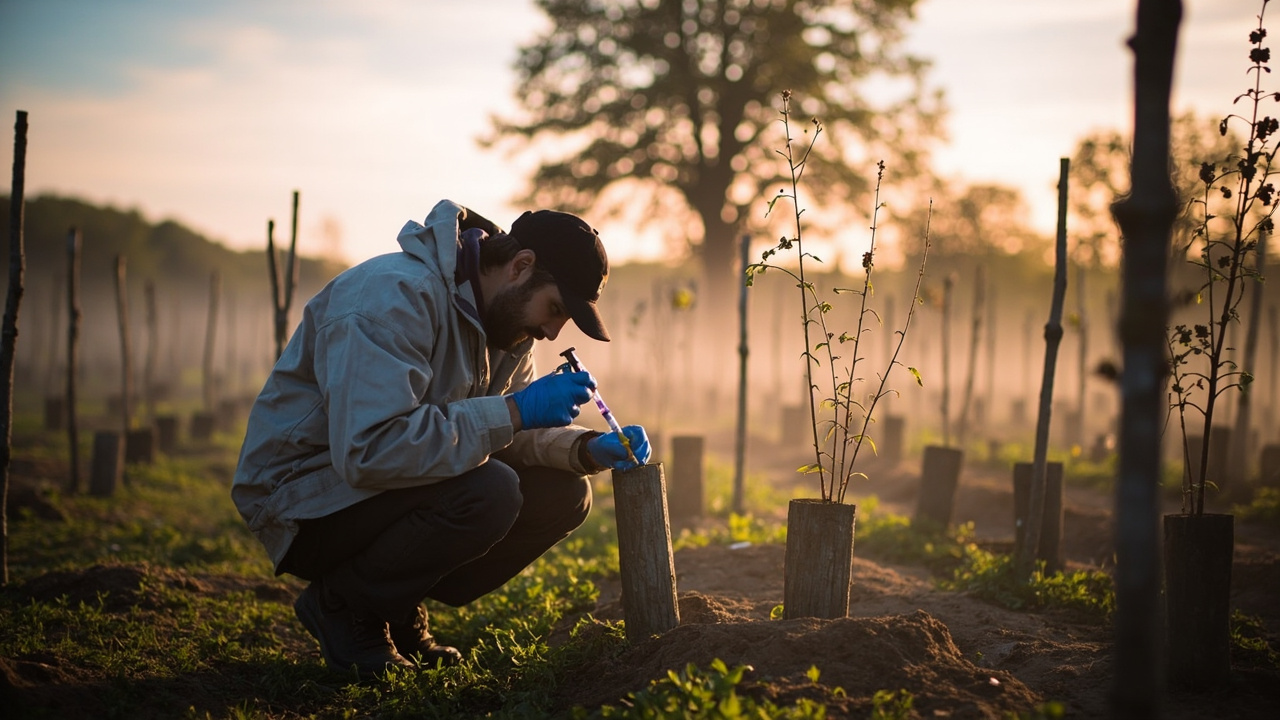
Workers introduced spores of the disease fungus directly into the young stems. The intent was not to destroy the planting, but to reveal variation in tolerance. Individuals that remain healthy after deliberate exposure will be retained. Individuals that develop severe disease will be removed from consideration for breeding.
The survivors are slated for a breeding program focused on disease-tolerant American elm. The program objective is to increase genetic diversity among tolerant trees, rather than relying on a very narrow set of parents. That diversity is considered important for long-term restoration plantings.
Those future plantings are envisioned for forests, riverbanks and backyards. The project therefore connects laboratory and nursery screening with eventual field use in both natural areas and populated landscapes.
The work was reported from Montpelier, Vermont, with additional reporting from Portland, Maine. Photography documented a mature American elm on the Eastern Promenade overlooking Casco Bay at dawn in Portland on June 4, 2026, and nursery inoculation work in Benson, Vermont, on May 19, 2026.
Why 6,000 seedlings matter
The scale of the Vermont trial reflects the biology of resistance. Tolerance is uncommon, so researchers need a large starting population to find enough survivors to sustain breeding, according to The Associated Press.
The 6,000 young elms were bred from a group of a few dozen trees in the Northeast that had survived Dutch elm disease. Those parent trees represent rare cases in which mature American elms persisted despite widespread mortality over the last century.
Tens of millions of elm trees have been killed over the last century. Millions of American elms have been decimated in the United States. Against that background, a few dozen survivors provide valuable but limited genetic material.
By crossing descendants of those survivors and then challenging the offspring with the pathogen, scientists can look for families that combine survival with broader parentage. The survivors of the Vermont inoculation will be propagated anew for breeding.
The emphasis on diversity is deliberate. A restoration population built from only one or two tolerant clones could be vulnerable to other pests, diseases or weather extremes. A broader seed base offers more options for different sites.
What happens to the survivors
Wilson described the next stage as establishment of a seed orchard, essentially a large fenced area where selected trees will be grown and tended. The trees are expected to require about 15 years before they produce seeds in quantity.
That seed would then supply restoration efforts. In practical terms, the timeline means that seed for widespread planting is not expected immediately. The nursery selection conducted in 2026 is an early stage in a multi-year sequence.
The fenced design is intended to protect the young breeding trees and keep their identity clear. Managers will tend the orchard through juvenile growth until reproductive maturity. Once seed production begins, collectors can harvest seed with known parentage.
Restoration users could include forest managers, watershed groups, municipalities and homeowners. The project description explicitly lists forests, riverbanks and backyards as intended destinations, indicating both ecological and community planting goals.
The approach differs from chemical protection of individual landscape trees. It seeks to develop populations that can be planted and reproduce with improved tolerance inherited from selected parents.
How Dutch elm disease kills
Dutch elm disease is caused by fungi that invade the water-conducting tissue of elm trees, according to the Nebraska Forest Service. The American elm, known scientifically as Ulmus americana, is the most susceptible species, although other elms also show susceptibility and can transmit and succumb to infection.
The fungi plug the xylem, the tissue that moves water through branches and stems. The tree responds by sending compounds to the infection site in an attempt to stop spread. That defensive response can plug additional xylem and worsen the blockage.
The fungus associated with the Vermont trial is described as arriving in the United States a little less than a century ago. It is spread by bark beetles. Adult elm bark beetles feed on small branches or twigs, and viable spores attached to the beetle body or mouthparts can pass from an infected elm to an uninfected elm during feeding.
Blocked water transport prevents trees from drinking normally, causing starvation. The disease is a key reason that towering elms more than 70 feet, or 21 meters, tall are less common in New England today than in earlier generations.
The Nebraska Forest Service states that the disease was first found in the United States in the 1930s, spread through the eastern United States, and was confirmed in Nebraska in the 1960s. Millions of elms have been killed, and finding a mature American elm in Nebraska is now described as quite rare.
How infection spreads between trees
Beetle transmission is only one pathway, according to the Nebraska Forest Service. Roots of neighboring elms can graft together when they touch, joining their vascular systems. Infection can then move through grafted roots from a diseased tree to a healthy neighbor.
Pruning tools can also transfer infection. Cuts made on an infected tree can spread the pathogen within the same tree if multiple cuts are made, or to another elm if tools are not sanitized between trees. Mishandling infected wood can expose nearby healthy elms.
For that reason, infected wood should be chipped or burned rather than left where beetles or people might move the pathogen. Proper diagnosis, pruning practices and wood disposal are listed as measures that can limit spread where the disease is known to occur.
Preventive fungicide and insecticide treatments can slow infection in areas where Dutch elm disease occurs. The Nebraska Forest Service states that there is no cure for the disease, although those management steps can reduce losses.
The Vermont breeding effort is therefore distinct from treatment of existing mature trees. It does not claim to cure infected individuals. It aims to produce new generations with a better chance of surviving exposure.
Signs landowners are asked to watch
Early symptoms include wilting leaves that turn yellow on one or more branches, according to the Nebraska Forest Service. Those leaves later turn brown, dry and brittle.
Beneath the bark of affected branches, vascular tissue shows brown or gray streaking. In cross-section, a branch displays a ring of discoloration. Those internal marks help distinguish Dutch elm disease from drought or other wilt problems.
Some trees die within a few weeks of visible symptoms. Others manage the disease for much longer, in some cases for more than a year. The rate depends on tree condition, timing and extent of vascular blockage.
The American elm was once widely planted along urban streets in Nebraska because it adapted to different soil conditions and developed a wide, picturesque canopy that provided considerable shade. That planting history increased exposure when the pathogen arrived.
All elms retain some level of susceptibility. That continued susceptibility is why the Nebraska Forest Service describes Dutch elm disease as a viable threat to elm trees in that state even today.
Why elms matter for water and climate
Forest Service research ecologist Kathleen Knight, based in Ohio, said American elms strongly influence the hydrology of surrounding ecosystems, according to The Associated Press. That function is especially relevant when unpredictable weather brings periods of flooding and drought.
The species is particularly important in wet forest areas. It tolerates flooding, survives cold northern winters, and can act like a sponge after rainfall. That water uptake and storage can reduce flooding that would otherwise damage river systems.
Knight said invasive pests and pathogens have heavily affected such tree species, and researchers are trying to return those species to the roles they previously played in forest systems. The elm effort is therefore framed as ecological repair, not only preservation of a familiar street tree.
The broader campaign against forest pests and diseases also touches industries such as logging. It affects fragile ecosystems where loss of a dominant or moisture-regulating tree can alter habitat for other plants and animals.
In Montpelier, a city that has experienced significant flooding through the years, the connection between canopy and water is visible. Arborist Joseph Ferris works beside a giant elm that has stood in Vermont's capital since the late 1800s, described as a reminder of what mature urban trees can provide.
A cultural landmark in New England
Senior conservation planner Gus Goodwin of The Nature Conservancy said the elm remains culturally important in the Northeast, according to The Associated Press. Although elms grow in many parts of the United States, they form a ubiquitous part of the landscape in New England towns.
The loss of large street and yard elms over recent decades has been deeply felt in those communities. Many residents associate elms with childhood homes and schoolyards. Goodwin noted that what is now missing is the presence of big trees.
He described a gravitational pull toward the elm and its loss. That attachment helps explain public interest in restoration, beyond timber value or flood control.
The surviving giant in Montpelier illustrates the former scale. Ferris called it a lovely reminder of what is possible for urban trees. Such survivors also supply inspiration and, in the Vermont project, genetic material for future generations.
Restoration along streets and riverbanks would return shade, habitat and familiar form to places where elms disappeared. Ferris said he would like to see resistant American elm available not only for urban planting but for restoration along streets and riverbanks, while boosting regional genetic resistance.
Ash trees face a parallel fight
American elms are not the only beloved trees under attack. Ash trees have succumbed to emerald ash borer, a beetle that has killed millions of trees since arriving in the United States in the early 2000s, according to The Associated Press.
The Appalachian Trail Conservancy has responded by injecting selected ash trees with an insecticide to improve survival chances. The group reported treating about 1,400 ash trees along the trail in North Carolina, Tennessee, Georgia and Massachusetts since 2016.
Emily Powell, southern non-native invasive species coordinator for the conservancy, said seeing healthy standing ash trees that remain a major component of the forest and support biodiversity is remarkable. The treated trees demonstrate that targeted protection can keep ash present in critical habitats.
The ash campaign differs operationally from the elm program. The elm drive is a breeding program based on inherited tolerance, while the ash effort is an inoculation and protection program for existing trees.
Together they illustrate two strategies now in use against invasive forest pests: develop resistant regeneration, and protect high-value standing trees. Both require repeated monitoring and long-term commitment.
What restoration will require
Even if the Vermont seedlings yield strong survivors, large-scale return of American elm will take time and coordination. The 15-year interval before a new seed orchard produces seed means nurseries, cities and forest owners must plan ahead.
Genetic diversity will need to be maintained through controlled crosses and record-keeping. Researchers intend to propagate survivors and track their performance. Seed orchard managers will need to guard against new pest introductions during the long juvenile period.
Site selection will matter. Since elms perform important work in wet forests, riverbanks and floodplains are logical priorities. Urban foresters will also weigh soil, space and maintenance needs before reintroducing tall elms to streets.
Monitoring for disease symptoms will remain necessary. Landowners are advised to seek diagnosis through the Nebraska Forest Service, a local extension office or a trusted arborist when wilt and vascular streaking appear. Sanitation of tools and proper disposal of infected wood remain relevant wherever elms grow.
Ferris described the prospect of resistant planting stock as a ray of hope amid visible infestation and damage in forests. For scientists, that hope rests on methodical screening: expose thousands of seedlings now, select the living, breed them carefully, and plant their seed for decades to come.
Sources referenced
- New generation of elm trees could be equipped to beat disease that killed parents - ABC News (https://ingest.abcnews.com/US/wireStory/new-generation-elm-trees-equipped-beat-disease-killed-136082979)
- Is Dutch Elm Disease Still in Nebraska? | Nebraska Forest Service (https://nfs.unl.edu/news/dutch-elm-disease-still-nebraska/)