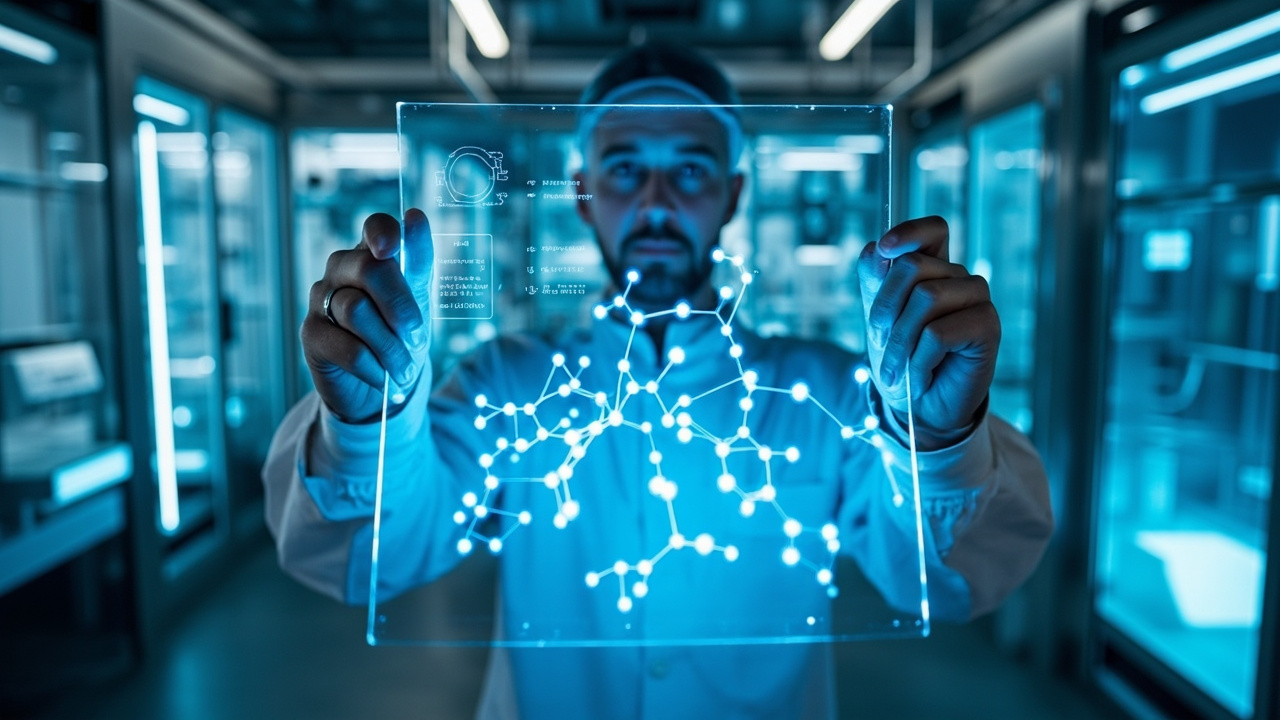
TL;DR: Harvard researchers designed more than 1,000 new blue-light-emitting organic molecules for OLEDs using a computer-driven Molecular Space Shuttle that screened more than 1.6 million candidates.
Harvard University researchers have designed more than 1,000 new blue-light-emitting molecules for organic light-emitting diodes, or OLEDs, that could improve displays for televisions, phones, tablets and more, according to Toward a better screen - Harvard CNS.
The interdisciplinary Harvard team developed the molecules in collaboration with Massachusetts Institute of Technology and Samsung.
The team developed a large-scale, computer-driven screening process called the Molecular Space Shuttle to identify the molecules.
The Molecular Space Shuttle incorporates theoretical and experimental chemistry, machine learning and cheminformatics.
The process was built to quickly identify new OLED molecules that perform as well as, or better than, industry standards, according to Toward a better screen - Harvard CNS.
The research is described in the current issue of Nature Materials.
The report was written by Leah Burrows for SEAS Communications and posted by Harvard CNS.
How OLED screens work
OLED screens use organic molecules that emit light when an electric current is applied.
Unlike liquid crystal displays, OLED screens do not require a backlight.
The absence of a backlight means the display can be as thin and flexible as a sheet of plastic.
Individual pixels can be switched on or off in an OLED display.
Switchable pixels improve the screen's color contrast and energy consumption.
OLEDs are already replacing LCDs in high-end consumer devices.
A lack of stable and efficient blue materials has made OLEDs less competitive in large displays such as televisions, according to Toward a better screen - Harvard CNS.
Why blue light is the hardest color
Like LCDs, OLEDs rely on green, red and blue sub-pixels to produce every color on screen.
It has been difficult to find organic molecules that efficiently emit blue light.
The biggest challenge in manufacturing affordable OLEDs is emission of the color blue, according to Toward a better screen - Harvard CNS.
To improve efficiency, OLED producers have created organometallic molecules with expensive transition metals such as iridium to enhance the molecule through phosphorescence.
That organometallic solution is expensive.
That organometallic solution has yet to achieve a stable blue color.
Aspuru-Guzik and his team sought to replace those organometallic systems with entirely organic molecules.
Alán Aspuru-Guzik, professor of chemistry and chemical biology, led the research.
Aspuru-Guzik said people once believed that this family of organic light-emitting molecules was restricted to a small region of molecular space.
Aspuru-Guzik said the team discovered a large set of high-performing blue OLED materials by developing a sophisticated molecular builder, using state-of-the-art machine learning and drawing on the expertise of experimentalists.
Aspuru-Guzik compared the required molecules to triathletes.
Aspuru-Guzik said it is easy to find a runner, easy to find a swimmer and easy to find a cyclist, but hard to find all three.
Aspuru-Guzik said the molecules have to be blue, stable and bright.
From 1.6 million candidates to more than 1,000 leads
The team began by building libraries of more than 1.6 million candidate molecules.
Researchers from the Harvard John A. Paulson School of Engineering and Applied Sciences, led by Ryan Adams, assistant professor of computer science, developed new machine-learning algorithms to narrow the field.
The algorithms predicted which molecules were likely to have good outcomes.
The algorithms prioritized those molecules to be virtually tested.
That prioritization effectively reduced the computational cost of the search by at least a factor of 10, according to Toward a better screen - Harvard CNS.
David Duvenaud, a postdoctoral fellow in the Adams lab and co-author of the paper, said the collaboration between chemistry and machine learning was natural.
Duvenaud said the early stages of the chemical design process start with millions of possible candidates.
Duvenaud said there is no way for a human to evaluate and prioritize all of them.
Duvenaud said the team used neural networks to quickly prioritize the candidates based on all the molecules already evaluated.
Adams said machine-learning tools are coming of age and starting to see applications in many scientific domains.
Adams said the collaboration was an opportunity to push the state of the art in computer science while developing new materials with practical applications.
Adams said it was rewarding to see designs go from machine-learning predictions to devices that can be held in the hand.
Rafael Gómez-Bombarelli, a postdoctoral fellow in the Aspuru-Guzik lab and first author of the paper, said the team could model the molecules in a predictive way.
Gómez-Bombarelli said the team could predict the color and brightness of the molecules from a simple quantum chemical calculation and about 12 hours of computing per molecule.
Gómez-Bombarelli said the team charted chemical space and found the frontier of what a molecule can do by running virtual experiments.
Half a million simulations and human judgment
Finding the molecules takes more than computing power and takes human intuition, said Tim Hirzel, a senior software engineer in the Department of Chemistry and Chemical Biology and co-author of the paper.
Hirzel and the team built a Web application for collaborators to explore the results of more than half a million quantum chemistry simulations.
The application was built to help bridge the gap between theoretical modeling and experimental practice.
Every month, Gómez-Bombarelli and Jorge Aguilera-Iparraguirre, another co-author and postdoctoral fellow in the Aspuru-Guzik lab, selected the most promising molecules.
The two researchers used software to create baseball cards, profiles containing important information about each molecule.
That process identified 2,500 molecules worth a closer look.
The team's experimental collaborators at Samsung and MIT then voted on which molecules were most promising for application.
The team nicknamed the voting tool molecular Tinder after the online dating app.
Hirzel said the team facilitated the social aspect of the science in a deliberate way.
Gómez-Bombarelli said the computer models do a lot, but the spark of genius is still coming from people.
Aspuru-Guzik said the success of the effort stems from its multidisciplinary nature.
Aspuru-Guzik said collaborators at MIT and Samsung provided critical feedback regarding the requirements for the molecular structures.
What the Molecular Space Shuttle changes
The Molecular Space Shuttle combines theoretical chemistry, experimental chemistry, machine learning and cheminformatics in one screening workflow.
The molecular builder expands the searched region beyond the small region of molecular space once associated with this family of organic light-emitting molecules.
The neural-network prioritization selects candidates based on molecules already evaluated.
The quantum chemical calculation predicts color and brightness before synthesis.
The Web application makes more than half a million simulation results explorable by collaborators.
The monthly baseball-card review condenses simulation output into profiles with important information about each molecule.
The 2,500-molecule shortlist focuses closer attention after the broader virtual screen.
The Samsung and MIT vote adds experimental and application requirements to the computational ranking.
The more than 1,000 resulting blue-light-emitting molecules expand the pool of candidates that perform as well as, or better than, industry standards.
Why televisions still need better blue
OLEDs are already replacing LCDs in high-end consumer devices.
Large displays such as televisions remain less competitive for OLEDs because stable and efficient blue materials have been lacking.
Green, red and blue sub-pixels are required to produce every color on screen.
Blue emission has been difficult to obtain efficiently from organic molecules.
Iridium-containing organometallic phosphorescent systems have not solved stable blue emission and add expense.
Entirely organic molecules are the alternative pursued by Aspuru-Guzik and his team.
The new set contains more than 1,000 blue-light-emitting organic candidates.
Blue OLED research was active across journals
The Harvard result arrived during a busy period for display research, according to Display paper briefing 2026, 27 September to 4 October.
That briefing checked 28 major journals in full for papers published from Sept. 27 to Oct. 4, 2026.
The check narrowed the field to 128 papers with a display connection.
The briefing introduced 15 papers and covered two in-depth articles separately.
The briefing identified blue OLED lifetime and efficiency as one axis of that week's work, alongside near-eye displays.
One highlighted paper addressed non-destructive lifetime prediction for blue phosphorescent OLEDs.
That paper was published in Nature Communications on Sept. 30 by Jeoungmin Ji of the School of Electrical Engineering at Korea Advanced Institute of Science and Technology and seven others, with Kyung Hee University and Hanbat National University.
The paper reported that conventional lifetime analysis is accelerated degradation testing that destroys the device.
The paper reported that the electroluminescence response under a magnetic field correlates with lifetime.
The paper reported that the magnetic field affects spin-pair dynamics and those dynamics are sensitive to degradation.
The paper reported a linear correlation with over 95% confidence between the strength of the magneto-electroluminescence response, termed fMEL, and device lifetime.
The paper reported that longer-lasting devices showed lower fMEL.
Another highlighted paper addressed blue emission efficiency and color purity together.
That paper was published in Nature Communications on Sept. 29 by Yi-Hui He of East China Normal University and seven others.
The paper proposed a bridged resonance structure that tunes triplet states for multi-resonance thermally activated delayed fluorescence.
The paper reported device external quantum efficiency of 40.2% and 36.9%, with color coordinates of CIEy 0.21 for blue and CIEy 0.08 for deep blue.
The paper reported 42.6% efficiency when built as a hyperfluorescent device, with suppressed efficiency roll-off, according to Display paper briefing 2026, 27 September to 4 October.
What to watch next for screens
The Harvard paper places its new molecules in Nature Materials as candidates that meet or exceed industry standards.
The Molecular Space Shuttle workflow links 1.6 million initial candidates, more than half a million quantum chemistry simulations, 2,500 closer-look molecules and more than 1,000 blue emitters.
The machine-learning step cut computational cost by at least a factor of 10.
The per-molecule quantum calculation required about 12 hours of computing.
The experimental vote by Samsung and MIT collaborators selected application-relevant molecules from the computational shortlist.
Future device testing will determine which of the more than 1,000 molecules deliver the required combination of blue color, brightness and stability in manufactured televisions, phones and tablets.
Sources referenced
- Display paper briefing 2026, 27 September to 4 October | DISPLAY NOW (https://display-now.nextio.ai.kr/en/article/2026-10-06-paper-week9-brief)