A Larval Pantry Protein Records Early Diet and Sets Adult Lifespan
TL;DR: Fruit flies fed less yeast protein as larvae lived longer as adults because they made less larval serum protein 2, kept fewer ribosomal proteins, and produced proteins more slowly in early adulthood.
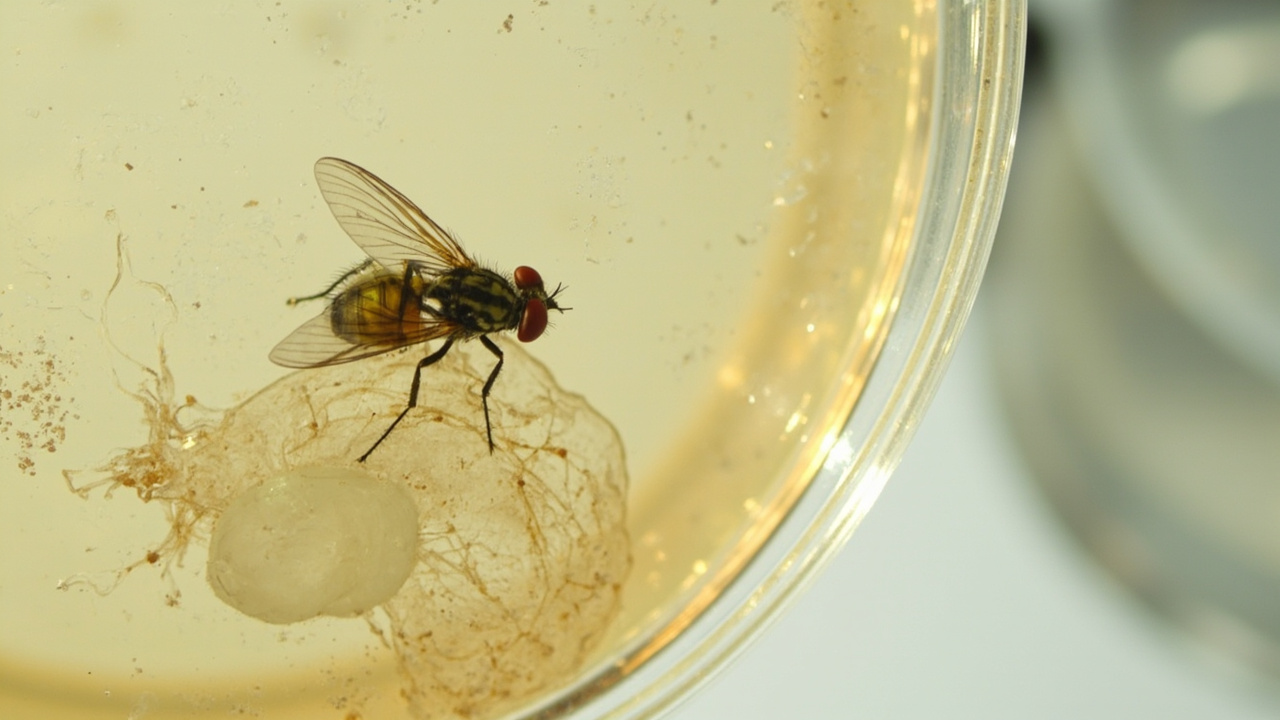
A team led by Fumiaki Obata at the RIKEN Center for Biosystems Dynamics Research in Kobe, Japan, identified larval serum protein 2, known as Lsp2, as a carrier of nutritional history across metamorphosis in Drosophila melanogaster, according to Ars Technica reporting on work published in Nature on September 23, 2026.
The experiments restricted protein only during the larval stage and then returned adults to standard food, yet adult lifespan increased in both males and females, as described in Lsp2 links early-life diet to adult translation and lifespan in Drosophila. The researchers called the persistent effect nutritional memory and traced it to storage of larval amino acids, durable suppression of Lsp2, reduced ribosomal-protein abundance, and lower translational activity during early adulthood.
Standard laboratory Drosophila eat a mixture of yeast and sugar in which yeast supplies most amino acids and protein. Late-second-instar larvae were moved to low-yeast food about 68 hours after egg-laying, with yeast reduced from 8 percent to either 2 percent or 1 percent, then adults were returned to a standard yeast-based diet after eclosion. Ars Technica described the switch as occurring roughly halfway through the larval period, with normal feeding resuming after emergence from pupae.
Nearly a century ago, restricted feeding during early life was reported to extend lifespan in rats and in Daphnia, specifically water fleas, and later work described related juvenile-diet effects in fruit flies and mice. The Nature study addressed the missing molecular carrier that could encode, preserve, and transmit early nutritional information through a nonfeeding pupal stage into adulthood.
Low Yeast As Larvae Extended Adult Life With Smaller Bodies
Both male and female protein-restricted flies outlived their well-fed siblings, even though the restriction ended before adulthood. The result matched the long-observed pattern in which reduced early nutrition can produce a longer adult life.
The longer-lived adults were paler and lighter. Female body weight fell in a dose-dependent manner by up to 28 percent, while wing size, a measure of overall body growth, fell by only 7.2 percent. Adults after early-life protein restriction showed lighter coloration of the body wall, particularly in the abdomen, potentially reflecting reduced melanin precursors such as tyrosine.
Development took longer on 8-percent to 2-percent or 1-percent yeast, but once larvae reached the pupal stage the eclosion rate was unaffected. Females also produced fewer eggs during adult days 2 through 7, with fewer ovarioles per ovary observed on day 4. Obata said reproduction and lifespan commonly show a trade-off relationship and that the early-life restriction produced slightly smaller flies with fewer eggs but extended lifespan.
Adding amino acids back to the low-yeast larval food removed the lifespan benefit. That reversal indicated that protein or specific amino-acid supply, rather than calories alone or another yeast component, drove the adult longevity effect. The team therefore searched for a body protein whose abundance remembered larval protein intake.
Isotope Tracing Showed Larval Food Persists Into Adult Heads
Comparison of adult gene activity between flies raised on low-protein and standard larval diets produced about 100 candidate proteins that might store information about early protein intake. The researchers examined candidates one by one for functional importance, according to Ars Technica.
To distinguish proteins built from larval food from those built after emergence, larvae were raised on a synthetic diet in which lysine and arginine contained rarer, heavier isotopes of carbon and nitrogen. After metamorphosis, adults received food containing the same amino acids labeled with different, lighter isotopes. Mass spectrometry then weighed protein fragments from adult heads, with the same fragment registering heavier or lighter depending on its dietary origin.
Three days into adulthood, nearly 64 percent of proteins detected in fly heads were still constructed from amino acids eaten by larvae. By day six, the larval-derived share remained about 46 percent. Ribosomal proteins were prominent among the retained proteins. Flies given restricted protein as larvae contained fewer ribosomal proteins and synthesized new proteins more slowly during the first week of adulthood.
The persistence was striking because pupae do not eat. Amino acids acquired by feeding larvae therefore had to be stored through metamorphosis in a form sensitive to the amount of protein eaten before pupation. The next step was to identify the storage molecule that survived development and responded to diet.
Lsp2 Linked Larval Protein To Adult Ribosomes
The leading candidate was larval serum protein 2, abbreviated Lsp2. Larvae produce Lsp2 in large quantities early in life and stockpile it as a pantry for metamorphosis, when feeding stops. Some Lsp2 carries over into the adult stage, and its abundance responds to early dietary protein.
Protein-restricted larvae produced less Lsp2, and Lsp2 remained low well into adulthood even after the flies resumed normal feeding. The researchers found that low larval Lsp2 appeared to instruct the adult body to continue producing less of the protein. In other words, an early shortage durably reset later production.
Genetic silencing of Lsp2 in larvae reproduced the dietary effect without changing food. Adults with larval Lsp2 knockdown had fewer ribosomal proteins, slower protein production, and longer lives, closely resembling flies raised on the low-protein larval diet, as reported in Lsp2 links early-life diet to adult translation and lifespan in Drosophila. The result supported Lsp2 as a causal link rather than a correlated marker.
Lsp2 is unusually rich in phenylalanine and tyrosine. Removing tyrosine from larval food, or reducing phenylalanine to one-quarter of its normal level, lowered Lsp2 and extended lifespan. Restricting isoleucine, an amino acid that occurs infrequently in Lsp2, did not extend lifespan. The authors concluded that shortage of the aromatic amino acids most needed to build storage proteins was sufficient to suppress early-life Lsp2 and promote longevity.
A Second Nature Study Connected Lsp2 To mTORC1
A companion paper published in the same September 23, 2026 issue of Nature, titled Lsp2 links mTORC1 to TOP mRNA translation and lifespan in Drosophila, examined Lsp2 from the nutrient-sensing side. It described Lsp2 as an adipose effector and feedback activator of mechanistic target of rapamycin complex 1, known as mTORC1.
In that second study, expression of Lsp2 was induced by essential amino acids through mTORC1 and gated by additional signals of nutrient sufficiency. Genetic ablation of Lsp2 extended lifespan robustly in that experimental setting. Translatomic profiling showed that loss of Lsp2 selectively reduced global translation of 5-prime-terminal oligopyrimidine motif-containing messenger RNAs, called TOP mRNAs, which mainly encode ribosomal proteins.
The TOP-mRNA effect depended on the 4E-BP translational repressor. The authors reported that Lsp2 promoted rapamycin-resistant phosphorylation of 4E-BP through mTORC1, making the Lsp2 mechanism distinct from rapamycin treatment. They also reported that TOP motifs co-emerged with 4E-BP during evolution and are present in nearly all Drosophila ribosomal-protein messenger RNAs.
Together, the two Nature papers place Lsp2 between amino-acid supply and the protein-making machinery. One paper emphasizes developmental carryover from larval diet to adult translation; the other emphasizes adult nutrient signaling through mTORC1, TOP messenger RNAs, and 4E-BP. A News and Views commentary by Linda Partridge of University College London, titled Surprising protein links dietary restriction to increased lifespan in flies, presented both findings as newly uncovered molecular mechanisms of dietary restriction in Drosophila melanogaster.
Why Slower Early-Adult Translation May Favor Longevity
The proposed sequence begins with less larval protein, leading to less Lsp2, resulting in fewer ribosomes and slower protein production in young adults, followed by longer adult life. The most firmly established portion is the final step, in which reduced translation and protein production leads to lifespan extension.
Lower translational activity can reduce the burden of producing highly abundant ribosomal proteins and other components during early adulthood. In the Obata-team experiments, the reduction was measurable during the first week after eclosion, when larval-derived amino acids still accounted for a large share of head proteins. The timing suggests that early adulthood is a consequential window for setting later aging trajectories.
The result does not mean starvation is beneficial. The experimental diets reduced yeast from 8 percent to 2 percent or 1 percent rather than eliminating food, and adults always returned to standard nutrition. Eclosion remained normal once pupation occurred, indicating that development could complete despite slower growth. The cost appeared as smaller size, paler cuticle, delayed development, and reduced early egg production.
The amino-acid specificity adds precision. Because Lsp2 contains large amounts of phenylalanine and tyrosine, limiting those two aromatic amino acids reproduced the longevity effect, while limiting isoleucine did not. Obata explained that low-tyrosine, low-phenylalanine larvae cannot make enough Lsp2, creating the same condition found under broader low-protein feeding.
What The Findings Do And Do Not Show
The work was conducted in Drosophila, a short-lived insect model widely used to dissect aging, growth, and nutrient signaling. Drosophila undergo complete metamorphosis, so mechanisms involving larval storage proteins may operate differently in animals without a pupal stage.
The studies do not prescribe low-protein diets for children or adults. Human dietary restriction can confer health benefits under defined conditions, but the present mechanism concerns larval serum proteins, insect metamorphosis, and fly ribosomal translation. Any broader relevance would require separate testing in mammals.
Several open questions remain about how low larval Lsp2 durably suppresses adult Lsp2 production after normal feeding resumes. Candidate explanations discussed in aging research include persistent changes in organ structure, epigenetic modifications, trade-offs among growth, reproduction, and somatic maintenance, metabolic and endocrine homeostasis, and gut microbiota, although the Nature paper identifies Lsp2 itself as the previously missing molecular carrier.
The immediate contribution is a concrete storage-to-ribosome pathway that can be manipulated genetically and nutritionally. By combining yeast dilution, synthetic amino-acid diets, heavy-isotope tracing, mass spectrometry, and larval Lsp2 silencing, the researchers separated the memory molecule from the many other changes caused by early diet. That separation makes Lsp2, phenylalanine-tyrosine supply, mTORC1 signaling, TOP messenger RNAs, and 4E-BP useful entry points for future experiments on nutritional programming and lifespan.
For now, the headline result is direct: less protein for maggots, mediated through less Lsp2 and slower early-adult protein synthesis, meant longer lives for the resulting fruit flies, as covered by Ars Technica on September 29, 2026.