TL;DR: A UCSF School of Pharmacy team led by James Fraser will use AI protein design plus high-throughput experiments to build stable scaffolds and test reaction chemistry for more predictable enzyme engineering under the DOE Genesis Mission.
A pharmacy-led team joins a national AI science push
A team from the UCSF School of Pharmacy has been selected for a new U.S. Department of Energy initiative aimed at harnessing artificial intelligence to accelerate scientific discovery, according to the Department of Bioengineering and Therapeutic Sciences report titled Researchers Leverage AI to Design New Generation of Enzymes.
The report, written by Katherine Tam and posted September 17, 2026, says the project will design new enzymes to create biotechnology tools for manufacturing, clean energy, waste treatment and more.
The work is framed as design research, not as a finished catalyst. The team will develop methods intended to make enzyme creation more predictable, with experimental validation built into the plan.
Principal investigator James Fraser, PhD, professor and chair of the Department of Bioengineering and Therapeutic Sciences, said the combination of AI advances with detailed experimental measurements creates an opening to improve predictability and to develop new catalysts for biotechnology and energy challenges, as quoted in that UCSF announcement.
The selection places a pharmacy-school protein-design group inside an energy-department program focused on manufacturing and energy problems. The project description links laboratory protein engineering to potential downstream uses in production, energy systems and waste handling.
The announcement does not list a completion date for the enzyme-design work. It describes a planned sequence of computational generation, structural testing and community sharing.
Who is leading the UCSF effort
Fraser leads the project as principal investigator and chairs the Department of Bioengineering and Therapeutic Sciences, according to the UCSF School of Pharmacy announcement titled Researchers Leverage AI to Design New Generation of Enzymes.
Co-investigators include Tanja Kortemme, PhD, and William DeGrado, PhD, both from the UCSF School of Pharmacy, and Aina Cohen, PhD, from the SLAC National Accelerator Laboratory.
The roster joins UCSF pharmacy researchers focused on protein structure, design and therapeutic science with a SLAC collaborator connected to X-ray structural measurement.
Kortemme and DeGrado bring School of Pharmacy affiliation to the effort. Cohen brings affiliation with SLAC National Accelerator Laboratory, where crystallography measurements are planned.
Fraser’s quoted statement ties the team’s strategy to two inputs: advances in AI and detailed experimental measurements. The statement presents predictability as the central technical goal, alongside development of new catalysts for biotechnology and energy challenges.
The UCSF announcement identifies the Department of Bioengineering and Therapeutic Sciences as Fraser’s departmental home. It also identifies the School of Pharmacy as the institutional home for Fraser, Kortemme and DeGrado.
The team structure therefore spans two Bay Area research organizations: UCSF in San Francisco and SLAC National Accelerator Laboratory. The SLAC role centers on seeing how small molecules involved in chemical reactions fit inside designed proteins.
What the Genesis Mission is
The project is among 278 selected through the Department of Energy’s Genesis Mission, according to the UCSF announcement.
The competitive process attracted more than 5,000 applications from around the country, described in that announcement as the largest response to a funding opportunity in the department’s history.
Genesis Mission brings together researchers with the DOE’s national laboratories, advanced AI tools and high-performance computing resources to rapidly design, test and refine new approaches to accelerate breakthroughs in energy, discovery science and national security.
A separate Genesis Mission account from GE Vernova titled Transforming Rotating Machinery Blade Design with AI reports the same selection scale: just 278 awards from more than 5,000 proposal submissions.
That GE Vernova account adds that Genesis Mission awardees gain access to the Genesis Mission Platform, including AI agent frameworks, advanced AI models and software provided by industry collaborators, and high-performance computing resources across DOE’s National Laboratories and partner facilities.
A University of Tennessee account of the program describes 277 Phase I proposals representing 342 participating institutions. A La Sierra University account reports 278 projects chosen from more than 5,000 applications, with 342 participating institutions including 142 colleges and universities.
The La Sierra account says Genesis Mission was announced in July by the Department of Energy. It describes the national initiative as bringing together government, industry and academic partners, combining artificial intelligence, supercomputing, quantum systems and advanced scientific instruments to support research in energy, scientific discovery and national security.
The Tennessee account describes the program as a $5 billion program to create a national ecosystem of AI tools and services addressing energy, scientific and engineering challenges. It says participants will work over the next nine months to bring AI tools, agents and workflows to life, with projects achieving promising results eligible to apply for additional Phase II funding in 2027.
A Rice University account titled Rice researchers earn 2 DOE Genesis Mission awards describes the initiative as a national effort harnessing artificial intelligence and advanced computing to accelerate scientific discovery. Rice’s two Phase I awards cover AI for quantum-computing optimization and AI-driven microbial production of isoprenoids.
Together, those independent university and industry accounts corroborate the UCSF description of a large, multi-institution, AI-plus-computing program spanning energy, discovery science and national security.
The long-sought enzyme goal
Scientists have long sought to engineer programmable and adaptable enzymes that could provide alternative ways to manufacture chemicals, detoxify waste and convert plant material and biomass into useful products, according to the UCSF announcement.
That sentence defines three intended application directions: alternative chemical manufacturing routes, waste detoxification and conversion of plant material and biomass.
The project’s broader biotechnology-tool framing adds manufacturing, clean energy and waste treatment as target areas for useful tools built from new enzymes.
Programmability here refers to the research aim of designing enzymes toward chosen functions, rather than relying solely on existing natural proteins. Adaptability refers to the aim of creating catalysts that can be adjusted for different manufacturing or energy tasks.
Conventional enzyme engineering provides the baseline mentioned in the announcement. The UCSF team’s effort is presented as a route that could give scientists greater control compared with conventional enzyme engineering, if successful.
The announcement does not claim that programmable, fully general enzymes have already been achieved. It presents faster, more predictable design and greater control as conditional outcomes dependent on success.
The manufacturing context in the announcement includes chemicals and biotechnology tools. The energy context includes clean energy and biomass conversion. The environmental context includes waste treatment and detoxification.
How “structure-seeded enzyme design” will work
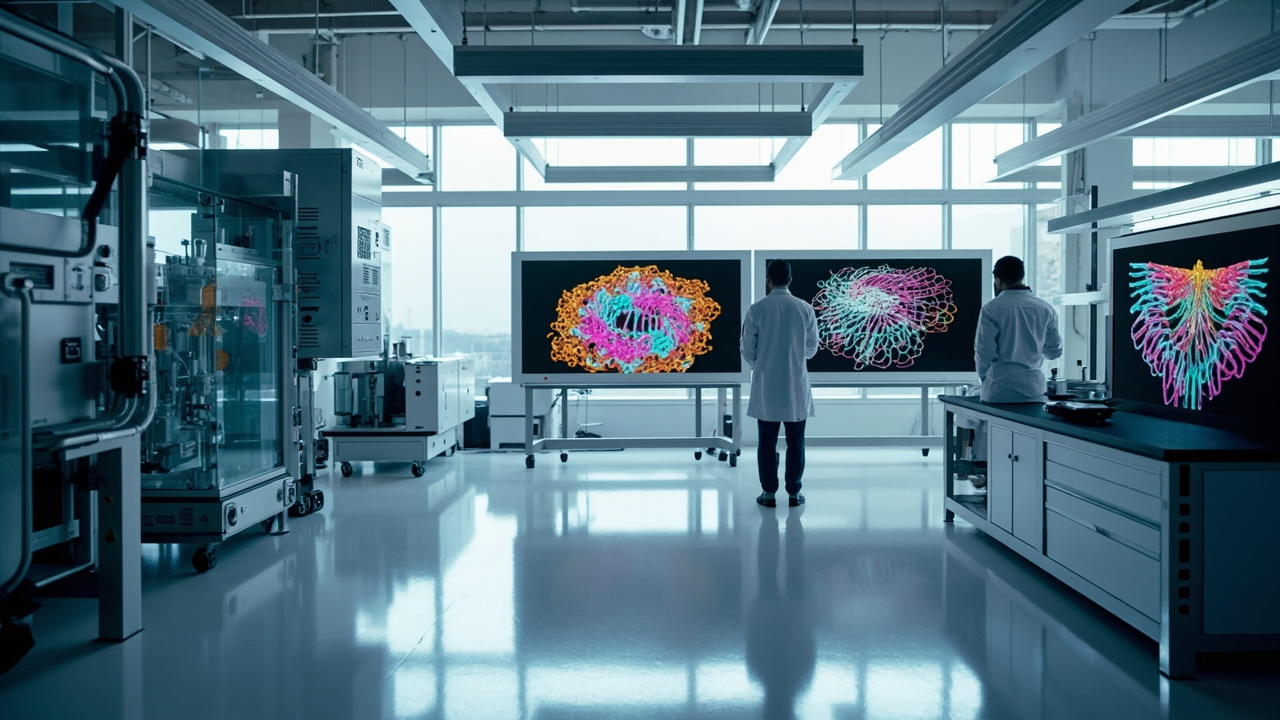
The UCSF School of Pharmacy-led team will develop an approach called “structure-seeded enzyme design” that combines AI protein design with high-throughput experiments to make enzyme creation more predictable.
The first step will use AI to generate large numbers of stable protein structures described as “scaffolds.”
The second step will use X-ray crystallography at SLAC to see how small molecules involved in chemical reactions fit inside those proteins.
That two-part sequence links computational generation of stable backbones with direct structural observation of chemistry-relevant small molecules inside the proteins.
High-throughput experiments are the complementary component to AI protein design in the described method. The stated purpose of pairing them is to make the process of creating programmable enzymes more predictable.
Fraser’s quoted comment connects the same two elements: advances in AI and detailed experimental measurements. The announcement presents measurement as the check on computation.
The SLAC crystallography role is central to that check. X-ray crystallography provides structural views of proteins and bound small molecules, allowing researchers to assess placement relevant to chemical reactions.
The announcement does not specify how many scaffolds will be generated, which reactions will be tested first, or which instruments at SLAC will be used beyond X-ray crystallography. It does not name a software model or a specific AI architecture for scaffold generation.
The technical scope therefore remains at the workflow level: AI generation, structural assessment of small-molecule fit and iterative refinement toward predictable design.
What the team plans to share
The researchers plan to make its models, chemical libraries, experimental structures, screening results and workflows available through the Genesis Mission infrastructure so other researchers in the initiative can build on the work, according to the UCSF announcement.
That sharing list covers five categories: computational models, chemical libraries, experimental structures, screening results and workflows.
The stated distribution route is Genesis Mission infrastructure. The stated audience is other researchers in the initiative.
The sharing plan matches the collaborative structure described for Genesis Mission, which connects academic teams with national laboratories, AI tools and computing resources.
The GE Vernova Genesis Mission account notes that awardees receive access to shared platform elements including AI agent frameworks, models, software and high-performance computing resources. The UCSF plan adds project-generated outputs to that shared environment.
The Rice Genesis Mission projects similarly describe open outputs, including open-source software and publicly available datasets in the quantum-optimization project, plus large sequence-to-function datasets for protein-DNA and protein-molecule interactions in the biomanufacturing project.
If successful, the UCSF project could lay the foundation for designing useful enzymes faster and more predictably, while giving scientists greater control compared to conventional enzyme engineering, according to the UCSF announcement.
That outcome is explicitly conditional. The words “if successful” and “could” mark faster design, improved predictability and greater control as potential results, not completed achievements.
The announcement does not state pricing, licensing terms or commercial availability for any resulting enzyme. It does not identify a first commercial product or manufacturing partner.
Why manufacturing, energy and waste groups are watching
Manufacturing interest follows the project’s stated aim to create biotechnology tools for manufacturing, including alternative ways to manufacture chemicals.
Clean-energy interest follows the stated aims around clean energy and conversion of plant material and biomass into useful products.
Waste-treatment interest follows the stated aims around waste treatment and detoxifying waste.
Each of those uses depends on catalysts that perform chosen chemical steps reliably outside their original biological setting. The UCSF announcement positions designed enzymes as possible tools for those settings.
The Genesis Mission context adds computing and measurement capacity. Advanced AI tools and high-performance computing resources are listed as program resources for rapid design, testing and refinement.
National laboratories are listed as partners in that design-test-refine loop. For UCSF, SLAC is the named laboratory collaborator for structural testing.
The broader Genesis Mission cohort shows how the same program resources are being applied elsewhere. Rice is pursuing AI-guided microbial production of isoprenoids as domestically produced alternatives to petroleum-derived solvents, fuels and materials. La Sierra is working on AI reliability for battery management and energy infrastructure. GE Vernova is developing an AI pipeline for rotating-machinery blade design for wind, gas power and hydro applications.
Those parallel projects do not validate the UCSF enzyme approach. They illustrate the program’s stated scope across energy, discovery science and national security, as described across the UCSF, Rice, La Sierra, Tennessee and GE Vernova accounts.
The UCSF project’s distinctive contribution, as described, is a shareable scaffold-first workflow plus structural data on small-molecule fit. Models, libraries, structures, screening outputs and workflows are the concrete deliverables other teams could reuse.
The next verifiable milestones to watch are therefore procedural: generation of stable scaffolds, crystallographic datasets showing small-molecule placement, screening results and public release of the listed models and workflows through Genesis Mission infrastructure.
Sources referenced
- Researchers Leverage AI to Design New Generation of Enzymes | Department of Bioengineering and Therapeutic Sciences (https://bts.ucsf.edu/news/2026/09/researchers-leverage-ai-to-design-new-generation-of-enzymes)
- Researchers Leverage AI to Design New Generation of Enzymes | School of Pharmacy (https://pharmacy.ucsf.edu/news/2026/09/researchers-leverage-ai-to-design-new-generation-of-enzymes)