TL;DR: Tyrannosaurus rex ran at about 97 degrees Fahrenheit, or 36.3 degrees Celsius, matching humans and confirming it made its own body heat.
A fossil-tooth thermometer has given paleontology its first direct number for the internal heat of Tyrannosaurus rex. According to UCLA, researchers measured tooth enamel and placed the animal at 97 degrees Fahrenheit, comparable to a human. As described in Science Advances, measurements from three T. rex teeth from the Late Cretaceous Hell Creek Formation yielded 36.3 ± 2.5 degrees Celsius, comparable to modern endotherms.
The result was published Sept. 16 in Science Advances. According to UCLA, the paper marks the first time scientists have an actual number for T. rex rather than an inference from growth or movement. The work was led by UCLA with collaborators at other institutions.
The central conclusion is that T. rex regulated a warm, elevated temperature. According to UCLA, a warm-blooded T. rex would have been an energetic predator or scavenger, not a sun-basking slowpoke. As described in Science Advances, comparison with proxy-derived temperatures and model simulations indicates that T. rex maintained a higher body temperature than its environment.
A human-like reading for the tyrant king
The headline figure is deliberately relatable. According to UCLA, T. rex was a relatable 97 degrees Fahrenheit, almost the same as humans. Co-author Robert Eagle said the team found T. rex was 36 Celsius, about the same as humans.
That places the predator between living reptiles and living birds. According to UCLA, modern, cold-blooded reptiles run about 28–30 C, or 82–86 F. Most birds, described as T. rex's evolutionary descendants, often run much warmer at 40–43 C, or 104–109 F. Eagle said the temperature was higher than a reptile or a slow mammal like a sloth, but lower than an avian.
The study frames the value as endothermic. As described in Science Advances, the 36.3-degree estimate was comparable to modern endotherms. According to UCLA, the 36 C body temperature is comparable to a furry, warm-blooded mammal, even though T. rex was still a scaly, egg-laying reptile.
The precision matters because earlier approaches could not settle the question. Prior isotopic work on T. rex bone phosphate and tyrannosaurid tooth enamel was limited by the confounding effect of body water composition, which is difficult to constrain, according to the description in Science Advances. The new determination was described as thermodynamically based and independent of body water composition.
Which fossils supplied the heat signal
The temperature comes from a small number of carefully chosen teeth. As described in Science Advances, three T. rex teeth came from the Late Cretaceous Hell Creek Formation. The specimens were provided for analysis by the Natural History Museum of Los Angeles County.
Two teeth were associated with specimen LACM 150167, identified as LACM 150167 EEEE3 and LACM 150167 PPPP. One additional specimen was an isolated partial T. rex tooth catalogued as LACM 151468. All were collected from a site southeast of Ekalaka in Carter County, Montana.
The associated skeleton has a public identity. LACM 150167 is nicknamed Thomas. According to UCLA, the museum provided portions of two teeth from Thomas the T. rex, described as the most complete of the towering tyrannosaur skeletons inside the museum's dinosaur hall. As described in Science Advances, Thomas is a well-preserved young adult that would have likely exceeded 3000 kg in life.
The team did not rely on T. rex alone. As described in Science Advances, five crocodilian teeth from the Hell Creek Formation were provided by the Raymond M. Alf Museum of Paleontology. Those teeth were collected from the upper Maastrichtian vertebrate fossil site UCMP V85092, near McGuire Creek in McCone County, Montana.
That comparison was central to the interpretation. As described in Science Advances, teeth of coeval Hell Creek Formation crocodilians yielded temperatures significantly lower than did those of T. rex. The offset supported different thermal strategies in animals that shared the same Late Cretaceous landscape.
Why enamel preserves a 66-million-year thermometer
Tooth enamel was selected because it endures. According to UCLA, tooth enamel has large crystalline structures that are extremely durable, making it the part of the skeleton that most resists chemical alteration by the environment over the eons. As described in Science Advances, all body temperature estimates were based on enamel, known to have the highest potential for preserving original isotopic composition.
Bone behaves differently. According to UCLA, bones are constantly being remodeled and dissolved and replaced. That turnover makes bone less suitable for a signal formed more than 60 million years ago.
The chemical principle involves rare isotopes. According to UCLA, rare isotopes of carbon and oxygen form bonds together inside tooth enamel. The number of those bonds increases in cooler temperatures and decreases in warmer temperatures. A warm-blooded animal will have fewer of these chemical bonds in the teeth than a cold-blooded animal.
The laboratory method is carbonate clumped-isotope paleothermometry. As described in Science Advances, it determines mineral formation temperatures from the abundance of 13C-18O bonds in carbonate minerals. The approach provides a direct determination independent of body water composition. Clumped isotopes in bioapatite minerals such as enamel, dentin and bone reflect vertebrate body temperatures, allowing temperature estimates in extinct taxa.
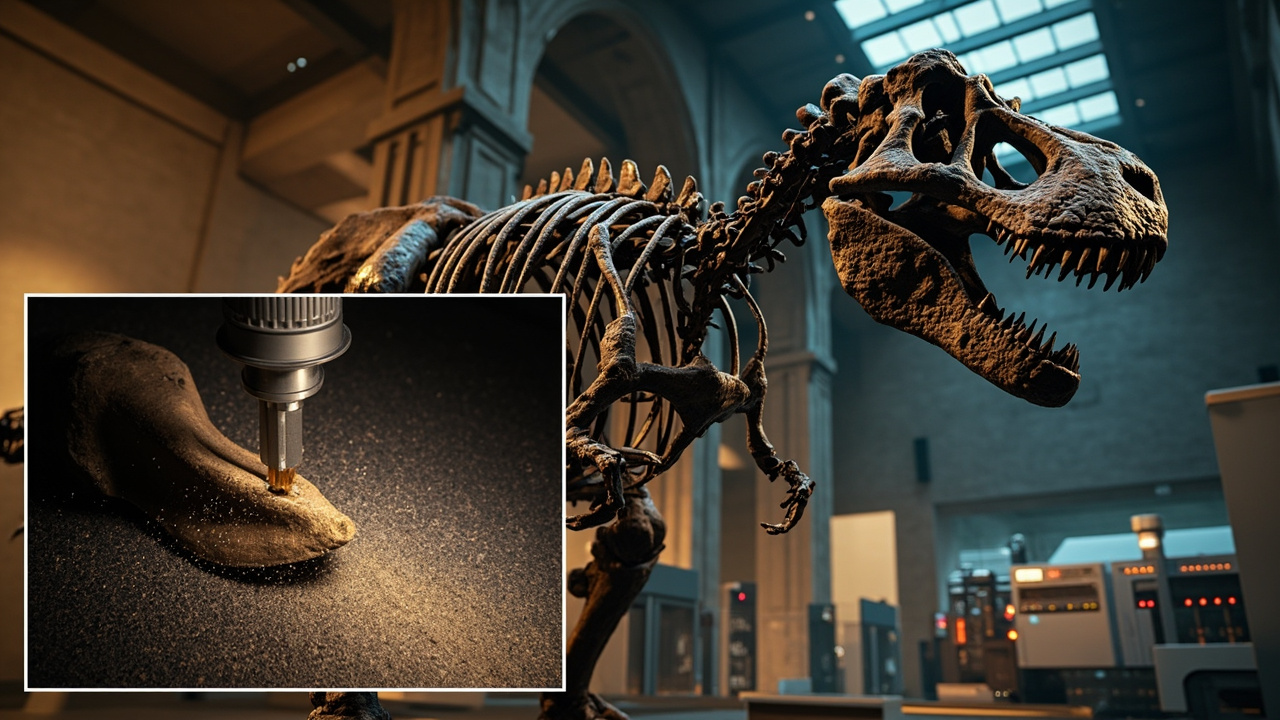
In practice, the team removed enamel and converted it to gas. According to UCLA, Eagle and lead author Randy Flores used a dental drill to remove enamel and dissolved the resulting powder in phosphoric acid to release carbon dioxide gas containing the isotope bonds. Measuring the gas with a mass spectrometer revealed the isotope ratios.
A technical refinement made the T. rex test possible. According to UCLA, pressurizing the gas created a denser jet of carbon dioxide, providing a large enough sample for the mass spectrometer from a smaller amount of material. That change reduced the amount of fossil material needed.
A decade-long path to a smaller sample
The Sept. 16 paper followed years of instrument development. According to UCLA, researchers developed the prehistoric thermometer method a decade ago, using bones to measure whether extinct animals were warm-blooded or cold-blooded. Testing it on T. rex initially required more bone than any museum would part with.
Over that decade, the team refined the process. According to UCLA, the group cut the amount of material needed for ancient dental testing by roughly 90 percent. That reduction was enough to convince the Natural History Museum of Los Angeles County to provide portions of teeth from Thomas.
The authors present the outcome as unusually clear. Eagle said no one had been able to make a temperature measurement like this before. Senior author Aradhna Tripati said enamel chemistry records the temperature at which enamel formed and can be read 66 million years later with a mass spectrometer.
The institutional credits span several organizations. The listed authors include Randon J. Flores, Robert A. Eagle, Robin B. Trayler, Gabriele Larocca Conte, Sora L. Kim, Alfio Alessandro Chiarenza, Alex Farnsworth, Paul J. Valdes, Luis Chiappe and Aradhna Tripati, as described in Science Advances. According to UCLA, Eagle is a UCLA geobiologist, Flores was the lead author, Tripati is a UCLA isotope geochemist and the senior author, and Chiarenza is a paleontologist at University College London.
Warm blood means an active hunter, not a basker
Physiology shapes behavior. According to UCLA, a thermoregulated T. rex supports theories that tyrannosaurs were active animals, chasing or scavenging food to fuel fast metabolisms. A warm-blooded T. rex would have been an energetic predator or scavenger rather than a slow animal waiting for sun.
The finding also addresses an evolutionary transition. While the presence of fossils in Alaska suggested that this prehistoric ancestor of birds was already on the evolutionary path from cold-blooded reptile to warm-blooded avian, there was no way to take T. rex's temperature until now, according to UCLA. Eagle said the result adds to the timeline showing how much this ancestor of modern, very warm-blooded birds had already diverged from cold-blooded dinosaurs.
The broader debate remains nuanced. As described in Science Advances, evidence from anatomy, bone histology, energetics modeling, phylogenetics and geographic distribution suggests endothermy developed in at least some dinosaur groups. Endotherm-like temperatures have been identified for selected genera within Theropoda, Sauropoda and Ornithischia through oxygen-isotope and clumped-isotope paleothermometry. The same account notes that fossil biomolecules and macroevolutionary modeling are consistent with a range of thermophysiological strategies across dinosaur clades, leaving continued discussion about particular taxa.
Within that debate, T. rex already had circumstantial support for elevated metabolism. As described in Science Advances, aspects of T. rex biology and ecology that provide evidence for an endothermic thermophysiology include locomotor costs, growth rates and geographic distribution. The new work adds a quantitative constraint where confident estimates of body temperature were lacking.
Cold crocodilians next door sharpen the contrast
The crocodilian control is important because the animals lived at the same time and place. As described in Science Advances, the crocodilian teeth were coeval Hell Creek Formation specimens. Their significantly lower temperatures showed that the warm T. rex signal was not simply a burial or environmental artifact.
The method was designed to separate body heat from environmental water. As described in Science Advances, carbonate clumped-isotope paleothermometry determines mineral formation temperature directly, rather than inferring it through body-water composition. That distinction addresses the limitation that affected earlier oxygen-isotope studies of bone phosphate and tooth enamel.
Preservation was explicitly evaluated. As described in Science Advances, determining preservation of primary isotopic composition is essential in isotope thermometry. The authors assembled information from diverse approaches, while noting that no single diagnostic method guarantees original isotopic composition.
The enamel focus reflects that concern. Because enamel has the highest potential for preserving original isotopic signals, the temperature estimates were restricted to enamel rather than dentin or bone, as described in Science Advances. According to UCLA, its durable crystalline structure resists chemical alteration over the eons.
From Mexico to Alaska: mapping where warm heat could live
Body temperature was then used to model where T. rex could survive. As described in Science Advances, projected habitat suitability based on the results shows that most of the North American paleocontinent, including colder and higher latitudes, were potentially accessible to the species. According to UCLA, paleoclimate models reconstructed a range in North America 66 million years ago that stretched from Mexico to Alaska, based on survival with a 97 F body temperature.
Climate context helps explain why range mattered. According to UCLA, T. rex adapted over millions of years to the hot-house conditions of the Cretaceous Period, described as one of the warmest periods in Earth's history and approximately 11–25 F warmer than today. Even in that warmer world, high-latitude winters posed a challenge.
Alaska is the decisive example. According to UCLA, winter in Alaska would have been too frigid for a cold-blooded dinosaur even during the baking heat of the Cretaceous Period. Paleontologists have not found fossils of lizards, turtles, crocodiles or other reptiles from Cretaceous Alaska, but they have uncovered Tyrannosaurus fossils there. Chiarenza said the team now has empirical evidence from the geologic thermometer to support that distribution.
The study therefore connects chemistry to geography. T. rex maintained a higher body temperature than its environment when compared with proxy-derived environmental temperatures and model simulations, as described in Science Advances. According to UCLA, a toasty T. rex could survive in a cooler habitable range, stretching into territory where cold-blooded animals would have faltered.
What scientists knew before the thermometer
Everything known about T. rex comes from ancient clues. According to UCLA, scientists gleaned everything known about the animal from clues left more than 60 million years ago. Though scientists found increasing evidence that T. rex was warm-blooded in recent years, the Sept. 16 study provided the first actual number, according to UCLA.
For an animal this famous, Tripati said it was remarkable how little was actually known. The published estimate fills that gap with a thermodynamically grounded value rather than another indirect inference.
The authors also look beyond one species. Eagle pioneered the approach to prehistoric body temperatures and hopes to apply the same technique to avian dinosaurs and ancient mammalian ancestors, according to accounts of the research. The reduced sample requirement, down by roughly 90 percent for ancient dental testing according to UCLA, makes museum specimens more accessible for future tests.
In the end, the portrait is of a familiar kind of warmth in an unfamiliar animal. A scaly, egg-laying reptile held a temperature comparable to a furry mammal and close to a human, above cold-blooded reptiles and below modern birds, according to UCLA. The three Hell Creek teeth, the five coeval crocodilian teeth, the mass-spectrometer gas measurements and the North American habitat model together support one concise reading: the king of the tyrant lizards made its own heat.
Sources referenced
- Scientists finally know the body temperature of the Tyrannosaurus rex | UCLA (https://newsroom.ucla.edu/releases/scientists-finally-know-the-body-temperature-of-the-tyrannosaurus-rex)
- The body temperature of Tyrannosaurus rex | Science Advances (https://www.science.org/doi/10.1126/sciadv.aeb7653)