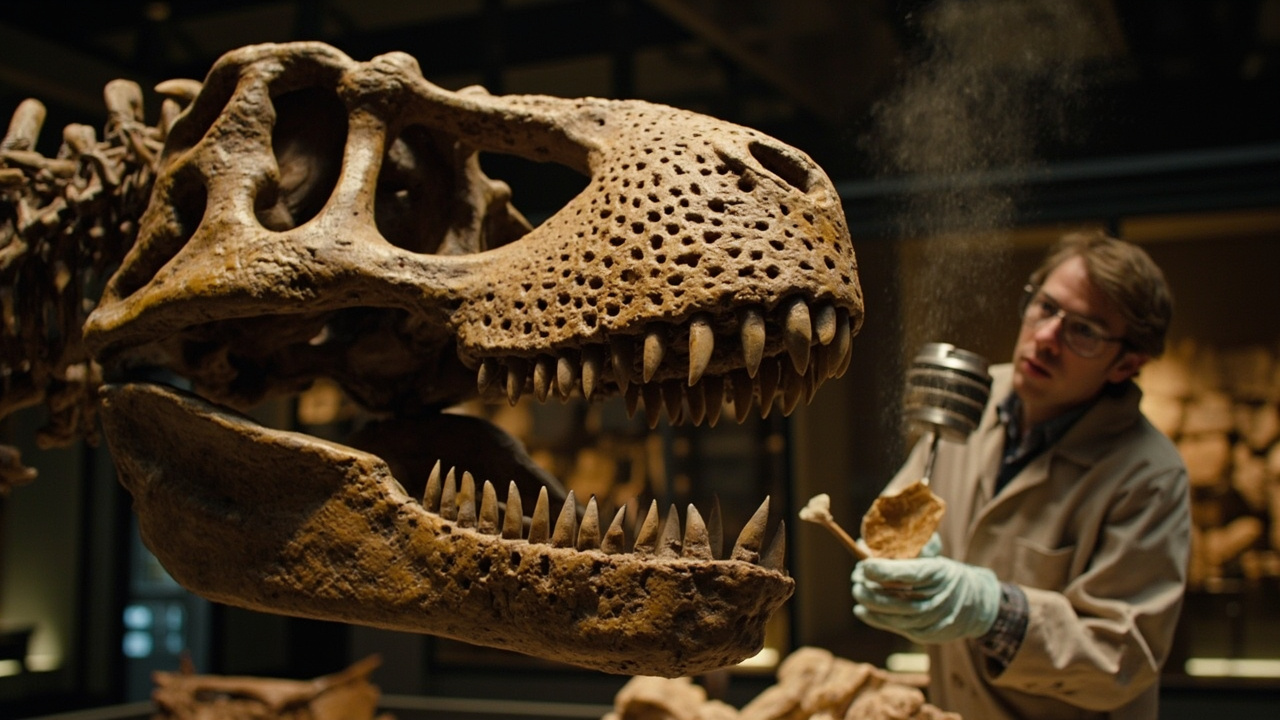
TL;DR: Scientists measured three Tyrannosaurus rex teeth from Montana and calculated a body temperature of 97.3 degrees Fahrenheit (36.3 degrees Celsius), showing T. rex was warm-blooded.
A thermometer locked in tooth enamel
Using chemical clues in Tyrannosaurus rex teeth, scientists have shown that this massive predator was warm-blooded — with a body temperature close to that of a person — according to Reuters.
The chemical makeup of the enamel in three T. rex teeth unearthed in Montana indicated that the dinosaur had a body temperature of 97.3 degrees Fahrenheit (36.3 degrees Celsius), plus or minus 4.5 F (2.5 C), according to Reuters.
For humans, the average body temperature is 98.6 F (37 C), according to Reuters.
More apt comparisons may be the average body temperature of the elephant, the most massive extant land animal, of around 97 F (36 C), and the ostrich, the largest extant bird, at roughly 102 F (39 C), according to Reuters.
Tyrannosaurus was among the most massive meat-eating dinosaurs, according to Reuters.
The new study's evidence that Tyrannosaurus was warm-blooded rebuts the obsolete notion of a sluggish brute, according to Reuters.
"It stops being a reptile in the way people picture reptiles. An animal at 36 degrees Celsius is not waiting for the sun to warm up. It is thermally independent of its surroundings, and in that respect closer to an elephant or an ostrich than to a crocodile," UCLA geoscientist Aradhna Tripati, senior author of the research published on Wednesday in the journal Science Advances, told Reuters.
The research was published on Wednesday in the journal Science Advances, according to Reuters.
Tripati is a geoscientist at University of California, Los Angeles, and senior author of the paper, according to Scientific American.
Robert Eagle, a co-author of the study and a geobiologist at University of California, Los Angeles, pioneered the approach to measuring prehistoric body temperatures, according to Scientific American.
Using tiny remains of T. rex tooth enamel found in modern-day Montana, scientists measured isotopes within the sample to estimate the dinosaur's temperature, according to Scientific American.
They found that T. rex likely ran at around 36 degrees Celsius — similar to the internal body temperature of modern-day humans, according to Scientific American.
"The enamel chemistry is truly recording the temperature at which it formed, and 66 million years later, we can read it using those measurements on a mass spectrometer," Tripati told Scientific American.
Tripati described the method as the next best thing to sticking a thermometer up a T. rex's 'butt,' which the team would not have wanted to do anyway, according to Scientific American.
Tyrannosaurus roamed western North America during the Cretaceous Period about 66 million years ago at the end of the age of dinosaurs, according to Reuters.
Measurements of three T. rex teeth from the Late Cretaceous Hell Creek Formation yield a temperature of 36.3 ± 2.5°C (1 SE), comparable to modern endotherms, according to the study in Science Advances.
Teeth of coeval Hell Creek Formation crocodilians yielded temperatures significantly lower than did those of T. rex, according to the study in Science Advances.
Comparison with proxy-derived paleotemperatures and model simulations indicates that T. rex maintained a higher body temperature than its environment, according to the study in Science Advances.
Projected habitat suitability for T. rex based on these results shows that most of the North American paleocontinent, including colder and higher latitudes, were potentially accessible to the species, according to the study in Science Advances.
How the clumped-isotope thermometer works
Teeth were the key to the study, according to Reuters.
"Tooth enamel forms inside the animal at body temperature, so the enamel chemistry is a thermometer," Tripati told Reuters.
The ratio of certain forms, or isotopes, of carbon and oxygen present in the enamel can reveal body temperature, through a method called "clumped isotopes," according to Reuters.
Carbonate clumped isotope paleothermometry provides an alternative approach for determining body temperature independent of body water composition through the direct determination of mineral formation temperatures based on the abundance of 13C-18O bonds in carbonate minerals, according to the study in Science Advances.
Prior isotopic works applied to T. rex bone phosphate and tyrannosaurid tooth enamel are limited due to the confounding effect of body water composition, which is difficult to constrain, according to the study in Science Advances.
Researchers have estimated dinosaur metabolism and growth rates before, but Tripati says the new study's method is especially precise at estimating internal temperature because tooth enamel and thermodynamic estimates aren't as sensitive to confounding factors such as environmental temperatures, according to Scientific American.
The researchers used a minimally destructive technique using a low-speed rotary drill with a tungsten carbide bit to take about 5 milligrams of enamel powder, less than a pinch of salt, from each tooth, according to Reuters.
Eagle says the findings are a culmination of some 15 years of work developing the technique, according to Scientific American.
"I’m excited that it worked so well because we’ve tried a lot of things with this technique, but this really seemed to be a clear result," Eagle told Scientific American.
Eagle added that the clear result gives him optimism that it will be useful for other questions, according to Scientific American.
The Montana fossils behind the result
The Natural History Museum of Los Angeles County provided the teeth, two from a well-preserved young adult specimen nicknamed Thomas and the other an isolated partial tooth from a second Tyrannosaurus, both from the same locale in Montana's Carter County, according to Reuters.
Three T. rex teeth were provided for analysis by the Natural History Museum of Los Angeles County including two teeth associated with specimen LACM 150167 and one isolated partial T. rex tooth cataloged as LACM 151468, according to the study in Science Advances.
Specimens were collected from the Late Cretaceous Hell Creek Formation from a site southeast of Ekalaka, Carter County, Montana, according to the study in Science Advances.
LACM 150167, nicknamed Thomas, is a well-preserved young adult T. rex specimen that would have likely exceeded 3000 kg in life, according to the study in Science Advances.
UCLA researcher Robert Eagle holds a Tyrannosaurus rex tooth, provided by the Natural History Museum of Los Angeles County, used in the study measuring this dinosaur's body temperature, in Los Angeles, California, in a handout image released on September 16, 2026, according to Reuters reporting carried by Yahoo News.
The researchers also applied the technique to five similarly old crocodilian teeth from the same rock formation, according to Reuters.
Additionally, five crocodilian teeth from the Hell Creek Formation were provided by the Raymond M. Alf Museum of Paleontology, according to the study in Science Advances.
These teeth were collected from the upper Maastrichtian vertebrate fossil site UCMP V85092 near McGuire Creek in McCone County, Montana, according to the study in Science Advances.
Determining the preservation of primary isotopic composition is essential in isotope thermometry, according to the study in Science Advances.
All body temperature estimates in this study are based on measurements of enamel, which is known to have the highest potential for preserving original isotopic composition, according to the study in Science Advances.
Crocodilians ran cooler in the same environment
The researchers found average body temperatures of 87.6 F (30.9 C) in the five crocodilian teeth, in line with modern crocs and lower than in Tyrannosaurus, according to Reuters.
The crocodilian result was in line with modern crocs, according to Reuters.
Teeth of coeval Hell Creek Formation crocodilians yielded temperatures significantly lower than did those of T. rex, according to the study in Science Advances.
Warm-bloodedness, also called endothermy, involves the ability of an animal to generate and conserve internal metabolic heat, according to Reuters.
This provides certain physiological advantages such as sustained energy and stamina, as well as the ability to thrive in warm and cold climes, according to Reuters.
Cold-bloodedness, or ectothermy, makes animals dependent upon external heat sources to warm up their bodies, like crocs and snakes, according to Reuters.
"Endothermy is common in large animals and even some fish. It comes at a cost, though," Eagle told Reuters.
"Higher metabolic rates mean higher food requirements and potentially more active hunting to acquire it. An endothermic T. rex would have had to acquire significantly more food to sustain its higher metabolic rate, but would also be capable of more sustained activity to find food and migrate, and live in colder environments," Eagle told Reuters.
Birds and mammals are endotherms, according to Reuters.
All meat-eating dinosaurs are part of a lineage called theropods, according to Reuters.
Birds are part of this lineage, having evolved from small feathered dinosaurs, according to Reuters.
Small flying birds today have a body temperature around 107 F (42 C), according to Reuters.
"Our temperature for T. rex sits at the low end of the endotherm range," Tripati told Reuters.
"It's thought that many dinosaurs, but not necessarily all, were warm-blooded," Eagle told Reuters.
Eagle said that even amongst warm-blooded organisms, there are questions of degree, according to Reuters.
They can be warm-blooded like sloths or anteaters, with low-level endothermy; modern large mammals; or avian endotherms, which typically have higher metabolic rates than mammals, according to Reuters.
A wider, colder-capable range
Its fossils are known from as far north as the Canadian provinces of Alberta and Saskatchewan, then south through the U.S. states of Montana, Wyoming and the Dakotas, and into New Mexico and Texas, according to Reuters.
Tripati said climate modeling indicates Tyrannosaurus would have been able to inhabit most of the continent, "including cold environments where it would have experienced freezing. That is a far more mobile and adaptable animal than the one people picture," according to Reuters.
Comparison with proxy-derived paleotemperatures and model simulations indicates that T. rex maintained a higher body temperature than its environment, according to the study in Science Advances.
Projected habitat suitability for T. rex based on these results shows that most of the North American paleocontinent, including colder and higher latitudes, were potentially accessible to the species, according to the study in Science Advances.
The findings suggest that, based on their temperature, T. rexes likely could have lived anywhere on Earth — even the Arctic, said Jasmina Wiemann, a paleobiologist at Johns Hopkins University and lead author of a 2022 study, according to Scientific American.
Wiemann was lead author of the 2022 study on dinosaur metabolism, according to Scientific American.
A 2022 study showed that dinosaurs likely had a range of metabolisms and estimated T. rexes that were on the lower end of endothermy, according to Scientific American.
This new paper, which finds T. rexes' body temperatures to be more similar to those of large mammals than those of smaller, hotter animals such as birds, complements those findings, said Wiemann, according to Scientific American.
The new study is "absolutely mind-blowing" and "impressively precise," Wiemann told Scientific American.
"It has been really, really exciting to be a young scientist in the field and watching how the collective evidence that we have from different isotope data is converging toward the same picture, suggesting that most nonavian dinosaurs were probably warm-blooded," Wiemann told Scientific American.
The dinosaurs were once considered reptilian, but the new results suggest researchers may need to rethink their evolution, according to Scientific American.
T. rex long faced reptilian stereotypes, but in recent decades research has shown that the dinosaurs were likely warm-blooded, according to Scientific American.
For years, paleontologists have been piecing together clues that suggest Tyrannosaurus rex may have been quite unlike modern reptiles — including the possibility that it may have been warm-blooded, according to Scientific American.
But scientists cannot stick a T. rex on a treadmill or put a thermometer in its mouth, so scientists must resort to more indirect methods to gauge dinosaurs' metabolisms and internal temperatures — such as the chemical composition of fossilized teeth, according to Scientific American.
One species, not a rule for all dinosaurs
"On other dinosaurs, I would be cautious about generalizing," Tripati told Reuters, regarding endothermy.
"This is one species, and the evidence across dinosaurs points to a range of strategies rather than a single answer," Tripati told Reuters.
Thermophysiology plays a crucial role in determining animal behavior and ecology, according to the study in Science Advances.
Paleophysiological studies are therefore essential for understanding how non-avian dinosaurs evolved and interacted with the varied climates and environments of the Mesozoic, according to the study in Science Advances.
While a consensus on thermophysiology across the clade Dinosauria has yet to be reached, current evidence from anatomy, bone histology, energetics modeling, phylogenetics, and geographic distribution suggests that endothermy developed in at least some dinosaur groups, according to the study in Science Advances.
Endotherm-like body temperatures have also been identified for select genera within Theropoda, Sauropoda, and Ornithischia through oxygen isotope paleothermometry and clumped isotope paleothermometry, suggesting that elevated body temperatures, and therefore high metabolic rates, were prevalent among dinosaurs, according to the study in Science Advances.
However, recent evidence from fossil biomolecules as well as macroevolutionary modeling and ancestral state reconstruction of paleoclimatic niches is consistent with the view that not all dinosaur clades maintained endothermic metabolisms and instead used a range of thermophysiological strategies in accordance with their environments and ecology, according to the study in Science Advances.
Tyrannosaurus rex is perhaps the most intensely studied dinosaur owing to a relatively well-sampled record, earning it the status of an exemplar organism that is commonly referenced in studies of vertebrate paleontology, according to the study in Science Advances.
Aspects of the biology and ecology of T. rex, which provide evidence for an endothermic thermophysiology, include locomotor costs, growth rates, and geographic distribution, yet confident estimates of body temperature were lacking before this work, according to the study in Science Advances.
What comes next for the fossil thermometer
Eagle hopes to use the same technique to suss out the body temperatures of avian dinosaurs and ancient mammalian ancestors next, according to Scientific American.
UCLA researchers — including Robert Eagle, a UCLA associate professor with a joint appointment in the Department of Ecology and Evolutionary Biology — used portions of Tyrannosaurus rex teeth to pin down the dinosaur's body temperature for the first time, placing it at 97 degrees Fahrenheit, comparable to that of a human, according to UCLA Life Sciences.
Readers can find the full university summary through UCLA Newsroom, according to UCLA Life Sciences.
The finding they reported should prompt a fundamental change in the perception of the celebrity dinosaur, according to Reuters.
The large meat-eating dinosaur lived in western North America and went extinct 66 million years ago, according to Reuters reporting carried by Yahoo News.
A 67-million-year-old T. rex skeleton named "TRX-293 TRINITY Tyrannosaurus" was seen during a preview at Koller auction house in Zurich, Switzerland on March 29, 2023, according to Reuters reporting carried by Yahoo News.
The skeleton of a Tyrannosaurus rex was displayed at the Smithsonian National Museum of Natural History in Washington on June 16, 2019, according to Reuters reporting carried by Yahoo News.
Sources referenced
- Tooth study shows T. rex was warm-blooded, with human-like temperature - Reuters via GMA News (https://www.gmanetwork.com/news/scitech/science/1002713/tooth-study-shows-t-rex-was-warm-blooded-with-human-like-temperature/story/)